

How an MBA in Sports Management Prepares You for the IPL Ecosystem

The Indian Premier League is one of the world’s largest sports businesses, valued at around US$9.6 billion in 2025 (Brand Finance). Behind every match are decisions about marketing, media rights, sponsorship, analytics, and event management worth thousands of crores. An MBA in Sports Management equips students with the skills to step into this fast-growing ecosystem, with career paths across franchises, leagues, broadcasters, and brand agencies.
If you love cricket, football or any other sports and want a career that combines that passion with business, an MBA in Sports Management is one of the most exciting choices available in 2026. This guide explains how the IPL actually makes money, what roles graduates take up, and why a focused university MBA programme prepares you better than a generic business degree.
The IPL Is a Business, Not Just a Sport
Most fans see the IPL as eight weeks of cricket every summer. The real story is much bigger. Here are a few numbers that capture the scale:
- IPL ecosystem value: around US$9.6 billion in 2025 (Brand Finance)
- IPL 2023 to 2027 media rights: ₹48,390 crore (around US$6.2 billion) in total (ESPN Cricinfo)
- For the first time, digital rights (with Viacom18) sold higher than TV rights, at ₹23,758 crore
- IPL 2025 viewership across JioStar platforms: 1.19 billion viewers (Variety, 2025)
- Peak concurrent digital streams during the IPL 2025 final: 55.2 million
- Most valuable franchise: Mumbai Indians at US$108 million brand value (Brand Finance, 2025)
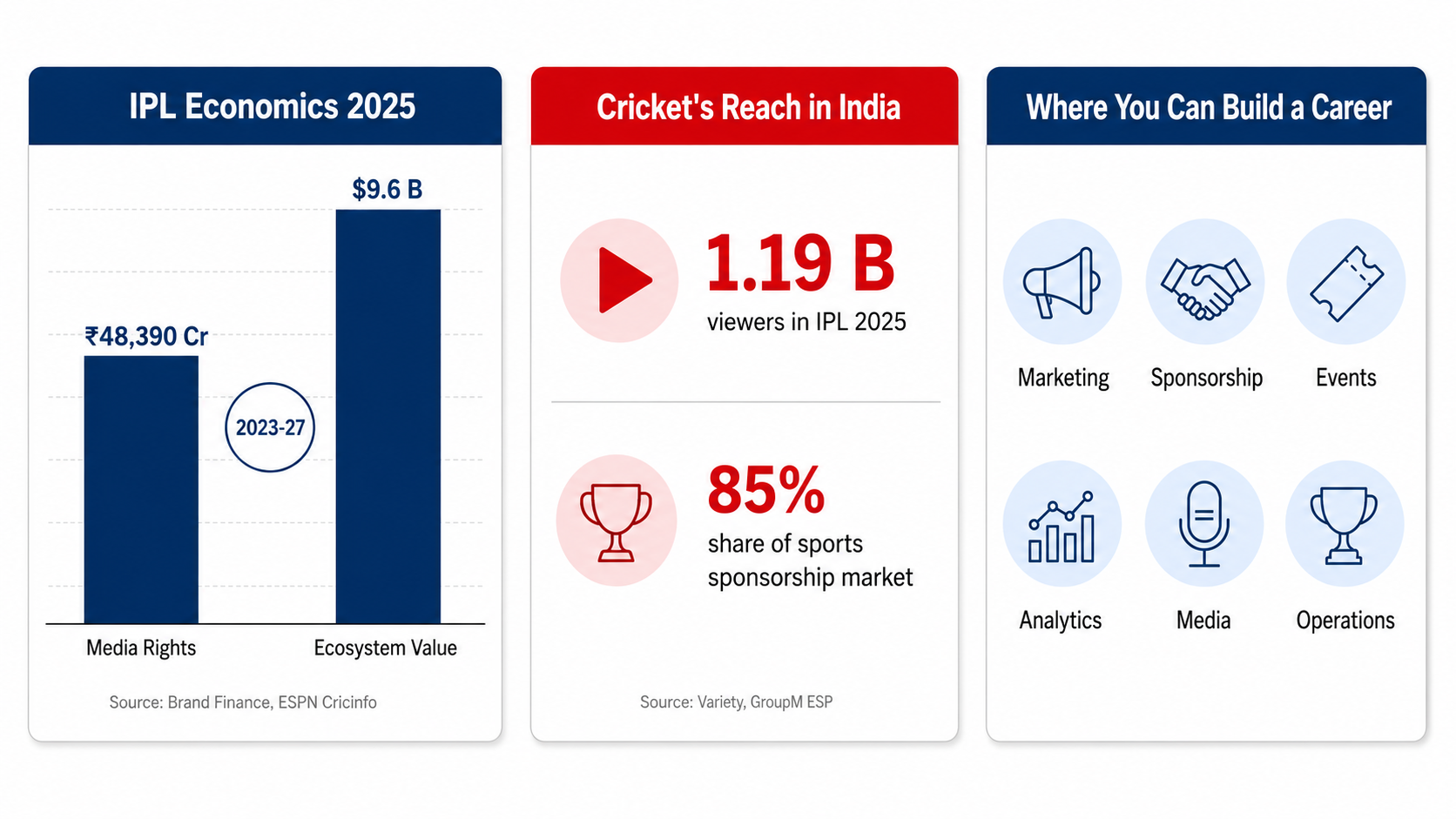
Behind every one of those numbers sits a team of professionals making decisions. Pricing media rights. Negotiating sponsorships. Planning fan experiences. Selling merchandise. Running analytics. Designing brand campaigns. That is the business of cricket.
What the IPL Ecosystem Actually Looks Like
The IPL is not just ten franchises. It is a layered business ecosystem.
- The league itself (BCCI and the IPL governing council)
- The franchises (ten team businesses, each a brand of its own)
- Broadcasters (Disney Star on TV, Viacom18 and JioStar on digital)
- Sponsors (title sponsor, official sponsors, team sponsors)
- Brand agencies that run campaigns for sponsors
- Event and venue partners (DY Patil Stadium, Wankhede, Eden Gardens, and others)
- Sports analytics firms that work with teams on player and game data
- Media houses, OTT platforms, and digital creators building content around the league
- Merchandise and licensing partners
- Talent agencies representing players and brand partnerships
A trained sports management graduate can build a career in any of these layers. That is the real value of this MBA.
What an MBA in Sports Management Equips You With
A focused sports MBA is not just business theory. It blends four things:
- Sports marketing and consumer behaviour: how fans engage, how merchandise sells, how brands tell stories
- Media rights, licensing, and sponsorship: the largest revenue engines of modern sport
- Event management and operations: tournament logistics, fan experience, stadium operations
- Sports analytics and data: from team strategy to fan segmentation
By the end, a student understands not just cricket, but how every leading sports league in the world makes money.
Top Career Roles in the IPL Ecosystem
A few examples of where MBA in Sports Management graduates land:
-
- Sports Marketing Manager (with a franchise, league, or agency)
- Sponsorship and Brand Partnerships Manager
- Media Rights and Broadcast Strategy roles
- Event Manager
- Sports Analyst
- Athlete Management and Talent Representation
- Operations Manager (stadium, venue, or franchise)
- Digital Content and Social Strategy Manager
- Merchandise and Licensing Manager
- Corporate Partnerships Manager (brands working with sports)
- E-sports Business Manager
- PR and Communications Manager for a sports organisation
Each of these roles needs a mix of business judgement and sports understanding. That mix is exactly what a sports MBA produces.
Salary Outlook in 2026
The Indian sports industry is growing fast. Sports sponsorships alone crossed ₹16,633 crore in India in 2024, with cricket accounting for around 85 percent of the total (GroupM ESP Sporting Nation, via Pitchonnet). Athlete endorsements alone touched ₹1,224 crore in 2024, a 32 percent jump year on year.
Typical salary ranges for sports management graduates in 2026 look like this:
| Experience Level | Typical Salary (per year) |
|---|---|
| Freshers (reputed sports MBA programmes) | INR 5 to 10 lakh |
| Mid-level (3 to 6 years) | INR 10 to 18 lakh |
| Senior roles (8+ years) at top franchises / agencies / broadcasters | INR 25 lakh and above |
Note: Salary ranges are based on published 2025 and 2026 sports industry guides. Actual offers depend on the institute, the employer, and prior experience.
Beyond IPL: Why Sports Management Is Future-Proof
Cricket is the biggest opportunity, but it is not the only one. The Indian sports market is projected to grow from around US$1.77 billion in 2025 to US$2.41 billion by 2030, expanding at roughly 6.4 percent CAGR (Mordor Intelligence). And that is just the spectator side.
Other growth engines include:
- Other Indian leagues: ISL (football), PKL (kabaddi), Pro Volleyball League, Ultimate Kho Kho, and the expanding Women’s Premier League
- Olympic sports: India’s medal tally has grown across recent Olympic cycles, creating careers in athlete management and federation roles
- Esports: a fast-growing, youth-led industry
- Sports tech: fitness analytics, wearables, sports software, and gaming
For a student joining a sports MBA in 2026, the runway is long, steady, and global.
Why VPSM, DY Patil University Is a Strong Choice
If you want a programme built for this exact ecosystem, the MBA in Sports Management at Vijay Patil School of Management (VPSM) at DY Patil University, Navi Mumbai, is a strong fit.
What makes the programme stand out:
- NAAC A++ accredited and AICTE approved
- Live event exposure at DY Patil Stadium, one of India’s leading cricket venues
- Strong focus on sports business, analytics, and the media ecosystem
- Integration of esports and global sports industry trends
- Continuous field immersion projects across every semester
- Industry mentorship from senior sports business professionals
- Harvard and other reputed institution certifications included in the programme
- 100 percent placement assistance through a dedicated placement cell
- A mandatory 8 to 12 week industry internship
Published on June 22, 2026
Contact us
