


Pain Awareness: Understanding Pain and Modern Pain Management

Pain is one of the most common reasons people seek medical care.
It may be a headache, back pain, joint pain, pain after an injury or surgery, nerve pain, cancer pain or pain that simply refuses to go away.
For some people, pain is temporary. For others, it starts affecting sleep, movement, work, studies, mood and quality of life.
That is why pain should not simply be ignored or repeatedly treated with painkillers without understanding the cause.
What Is Pain?
Pain is not just a physical sensation.
The International Association for the Study of Pain describes it as an unpleasant sensory and emotional experience related to actual or potential tissue damage.
In simple terms:
Pain is real, but the amount of pain does not always equal the amount of visible damage.
Two people with similar MRI findings may experience very different levels of pain.
This is why good pain treatment starts with understanding the person, not just the scan.
September Is Pain Awareness Month
In 2026, the International Association for the Study of Pain is also focusing globally on neuropathic pain — pain caused by disease or injury affecting the nervous system.
The broader message is simple:
Understand pain better so that it can be managed better.
Published on October 6, 2026
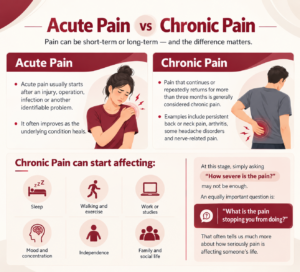
Acute Pain vs Chronic Pain
Acute Pain
Acute pain usually starts after an injury, operation, infection or another identifiable problem.
It often improves as the underlying condition heals.
Examples include:
- Cuts, burns, or other injuries
- Pain after surgery
- Sprains and fractures
- Toothache
- Infections or inflammation
Chronic Pain
Pain that continues or repeatedly returns for more than three months is generally considered chronic pain.
Examples include persistent back or neck pain, arthritis, some headache disorders and nerve-related pain.
Chronic pain can start affecting:
- Sleep
- Walking and exercise
- Work or studies
- Mood and concentration
- Independence
- Family and social life
At this stage, simply asking “How severe is the pain?” may not be enough.
An equally important question is:
“What is the pain stopping you from doing?”
That often tells us much more about how seriously pain is affecting someone’s life.

Different Types of Pain
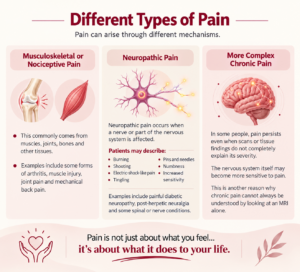
Pain can arise through different mechanisms.
Musculoskeletal or Nociceptive Pain
This commonly comes from muscles, joints, bones and other tissues.
Examples include some forms of arthritis, muscle injury, joint pain and mechanical back pain.
Neuropathic Pain
Neuropathic pain occurs when a nerve or part of the nervous system is affected.
Patients may describe:
- Burning
- Shooting
- Electric-shock-like pain
- Tingling
- Pins and needles
- Numbness
- Increased sensitivity
Examples include painful diabetic neuropathy, post-herpetic neuralgia and some spinal or nerve conditions.
More Complex Chronic Pain
In some people, pain persists even when scans or tissue findings do not completely explain its severity.
The nervous system itself may become more sensitive to pain.
This is another reason why chronic pain cannot always be understood by looking at an MRI alone.
What Is Modern Pain Management?
Pain management today is much more than prescribing painkillers.
The treatment depends on:
- The cause of pain
- How long it has been present
- The likely pain mechanism
- Examination findings
- Relevant scans or tests
- How much the pain is affecting daily life
Treatment may include:
- Interventional pain procedures in selected patients
- Education and self-management – Lifestyle changes
- Appropriate medicines
- Physiotherapy, Exercise and rehabilitation
- Psychological or behavioural support
- Treatment of the underlying condition
Many patients benefit from a combination of these approaches.
What Are Minimally Invasive Pain and Spine Interventions?
For some patients, medication and rehabilitation alone may not be enough.
In carefully selected cases, a pain physician may consider Minimally Invasive Pain and Spine Interventions – MIPSIs.
These are targeted procedures, often performed under fluoroscopy or ultrasound guidance, to reach a particular joint, nerve or pain-generating structure accurately.
Depending on the problem, they may include:
Targeted Injections and Nerve Procedures
Examples include selected epidural procedures, nerve-root treatments, joint injections and peripheral nerve procedures.
Radiofrequency Ablation Treatment
Radiofrequency procedures can reduce pain signals from selected nerves in conditions such as certain forms of spinal joint pain or joint-related pain.
Treatment for Complex Nerve or Cancer Pain
Specialized nerve blocks and sympathetic procedures may sometimes be used for neuropathic pain, complex regional pain conditions or cancer-related pain.
Minimally Invasive Spine Procedures
Selected spinal conditions may be treated with minimally invasive techniques, including some endoscopic spine procedures.
Vertebroplasty and Kyphoplasty
These may be considered in selected patients with painful vertebral compression fractures.
Neuromodulation
Treatments such as spinal cord stimulation may help selected patients with difficult chronic neuropathic pain when other appropriate treatments have not provided enough benefit.
These procedures are not necessary for every patient with pain.
The correct treatment should follow proper diagnosis, examination, appropriate investigations and a discussion of benefits, risks and alternatives.
Published on October 6, 2026
When Should You See a Doctor for Pain?
Minor pain often improves with time and simple self-care.
But medical assessment may be useful when pain:
- Keeps returning
- Persists for weeks or months
- Is progressively worsening
- Disturbs sleep
- Restricts walking or movement
- Affects work or studies
- Is associated with numbness or weakness
- Has no clear explanation
- Starts significantly affecting daily life
Severe pain associated with major injury, sudden weakness, loss of bladder or bowel control, high fever or other concerning symptoms may require urgent medical attention.

What Does a Pain Physician Do?
A pain physician evaluates patients with acute, chronic and complex pain.
The aim is not simply to prescribe medicines or perform procedures.
The role is to identify:
Where is the pain coming from?
What mechanism may be causing it?
How much is it affecting the person’s life?
And what treatment is most appropriate?
Depending on the condition, treatment may involve medicines, rehabilitation, lifestyle changes, collaboration with other specialists and, when appropriate, minimally invasive interventions.
Pain physicians may also work with orthopaedic surgeons, neurologists, neurosurgeons, physicians, oncologists, physiotherapists, psychologists and other healthcare professionals.
The Most Important Message This Pain Awareness Month
Pain should neither be ignored nor feared unnecessarily.
Instead, it should be understood.
For patients, one useful question is:
“What is this pain stopping me from doing?”
For healthcare professionals, an equally important question is:
“Why is this person still hurting?”
Because good pain management is not only about reducing a number on a pain scale.
It is about helping people sleep better, move better, work better and return to the life that pain has interrupted.
Understand the pain but treat the person!
Dr. Sidharth Verma
Professor, Department of Anaesthesiology
In-Charge, Pain Clinic, D.Y. Patil University, Navi Mumbai
Mentor – Fellowship in Pain Medicine
Interventional Spine & Pain Physician
Published on October 6, 2026
Contact us
