

Scope of MBA in Pharmaceutical Management in India: Careers, Salary and Growth in 2026

With rapid growth in pharmaceuticals, biotechnology, and healthcare innovation, India’s pharma industry now demands professionals who can combine scientific understanding with strategic business management. If you are a student or a parent exploring a future-ready career path, an MBA in Pharmaceutical Management is one of the most rewarding choices available today.
The Indian pharmaceutical market is currently valued at around USD 50 billion and is projected to touch USD 130 billion by 2030, according to the Press Information Bureau and IBEF. India is the world’s third-largest producer of medicines by volume and supplies nearly 20 percent of global generic medicines.
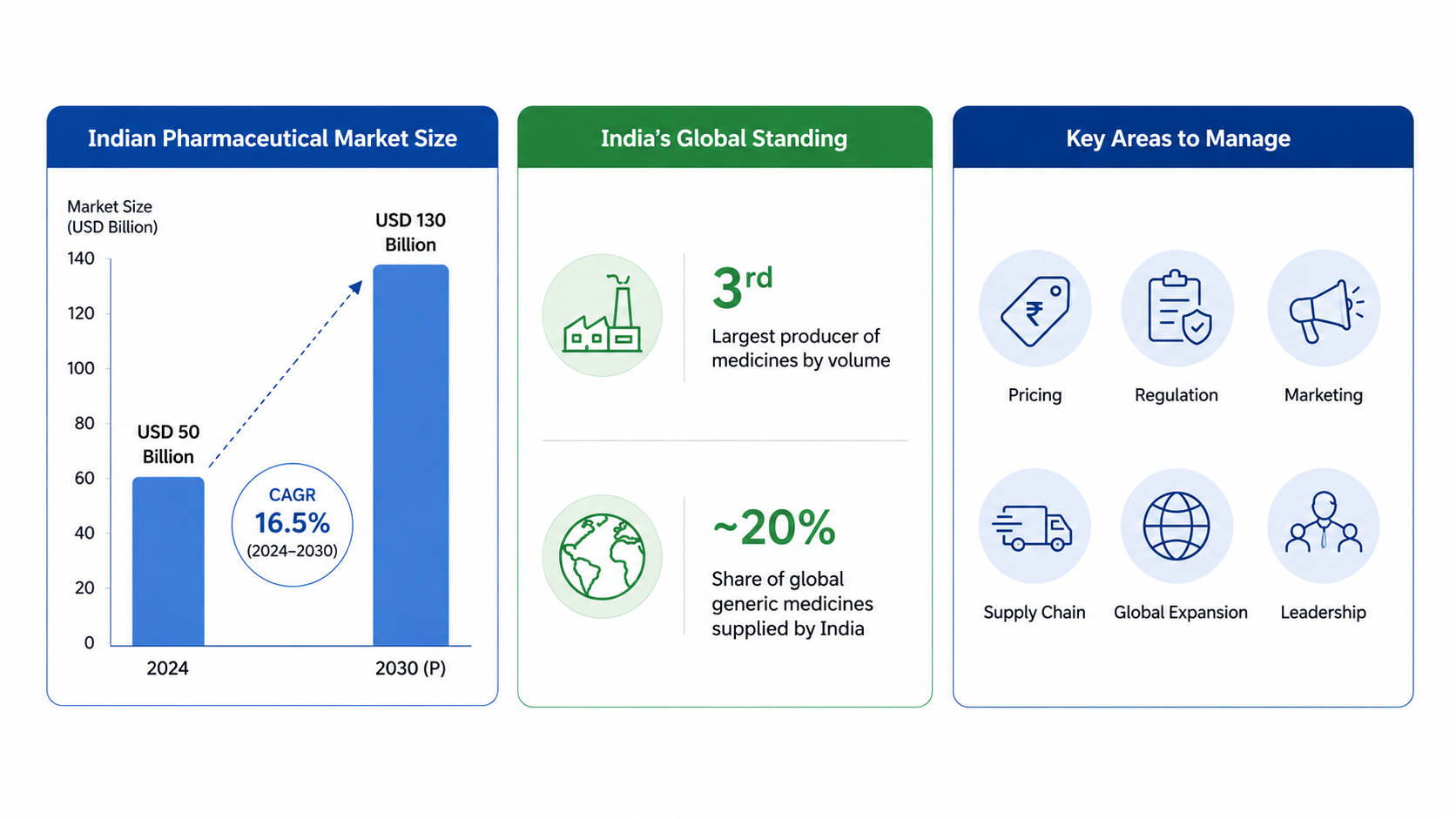
With this kind of growth, the country needs not just scientists but also the business leaders to manage pricing, regulation, marketing, supply chain, and global expansion. That is exactly where a Pharma MBA fits in.
What is an MBA in Pharmaceutical Management?
MBA in Pharmaceutical Management is a two-year postgraduate programme that blends core business education with deep knowledge of the pharmaceutical and healthcare industry. Students learn marketing, finance, and strategy, but they also study drug development cycles, regulatory frameworks (FDA, EMA, CDSCO), pharmacovigilance, market access, and healthcare innovation.
This Pharma management course is developed for Bachelors of Pharmacy, Science, Life Sciences, Biotechnology, Biomedical Engineering, Medicines who aspire to make career in pharma and biotech world.
Why the Scope of MBA in Pharmaceutical Management is Growing in India
Several real, measurable trends explain why this degree has strong career value in 2026 and beyond.
1. India is a global pharma leader
India exports medicines to more than 190 countries. Pharmaceutical exports crossed USD 30 billion in FY 2024-25, and around 50 percent of these exports go to highly regulated markets such as the United States and Europe. This scale of operations needs trained managers in compliance, regulatory submissions, and international market access.
2. Rapid sector growth and government support
Production Linked Incentive (PLI) schemes, the Bulk Drug Park policy, and the Pharma Vision 2047 are pushing domestic manufacturing and innovation. Companies are hiring people who can translate this policy push into business growth.
3. Rise of biotech and digital health
Biosimilars, gene therapy, telemedicine, and AI-driven drug discovery are no longer side topics. They are core to the industry. Pharma MBA gives students the framework to manage these new business lines.
4. Pharma is recession-resistant
Healthcare is essential. Even during economic slowdowns, the demand for medicines remains stable. This makes a pharma management career more secure compared to many other sectors.
What You Study in an MBA in Pharmaceutical Management
A strong MBA pharmaceutical management programme typically covers:
- Pharmaceutical marketing, product management, and brand strategy
- Pricing, reimbursement, and market access strategies
- Pharma supply chain, quality systems, and compliance
- Intellectual Property Rights (IPR) and global regulatory affairs (FDA, EMA, CDSCO)
- Biotechnology business management
- Digital health and healthcare analytics
- Pharmacoeconomics and pharmacovigilance
- General management foundations: finance, HR, operations, and strategy
At Vijay Patil School of Management (VPSM), DY Patil University, the curriculum is structured around 102 credits comprising of 72 core credits and a mandatory 8 to 12 weeks industry internship, thus students graduate with both classroom learning and on-ground experience.
Career Scope: Top Job Roles After MBA in Pharmaceutical Management
The most common question from parents and students is simple. What kind of jobs do graduates actually get? Here is a clear list of roles available across pharmaceutical, biotech, and healthcare companies.
- Product Manager (Prescription and OTC drugs)
- Pharmaceutical Brand Manager
- Regulatory Affairs Manager
- Medical Affairs Manager
- Market Access and Payer Relations Manager
- Healthcare Consultant
- Business Development Manager
- Supply Chain Manager (Pharma)
- Biotechnology Business Strategist
- Pharmaceutical Sales and Key Account Manager
Each of these roles connects the science of medicine with the business of healthcare, and most of them are very difficult to fill without specialized pharma MBA training.
Salary After MBA in Pharmaceutical Management in India
Salary is one of the strongest reasons why students pick this stream. While exact numbers depend on the institute, location, and prior experience, the broad pattern in 2026 looks like this:
| Experience Level | Salary Range (INR per annum) |
|---|---|
| Freshers (reputed pharma MBA colleges) | 6 to 12 LPA |
| Mid-level (3 to 5 years) | 15 to 25 LPA |
| Senior roles (8+ years) | 30 to 50 LPA + bonuses |
| Global / MNC leadership | Higher, role-dependent |
Cities such as Mumbai, Hyderabad, Bengaluru, and Ahmedabad are major pharma hubs and offer the strongest packages. Navi Mumbai, where VPSM is located, is itself a leading pharma corridor, which adds to internship and placement value.
Industries That Hire Pharma MBA Graduates
The scope of an MBA for pharmaceutical industry roles is not limited to medicine manufacturers. Graduates work across:
- Pharmaceutical companies (Indian and multinational)
- Biotechnology and life sciences firms
- Contract Development and Manufacturing Organisations (CDMOs)
- Hospital chains and healthcare providers
- Health insurance and payer organisations
- Medical devices companies
- Healthcare consulting firms
- Digital health and health-tech start-ups
- Regulatory bodies and policy think-tanks
This wide spectrum is what makes a pharma MBA course flexible. A student can shift between marketing, regulatory work, and consulting through their career without losing direction.
Future Outlook: What 2026 to 2030 Looks Like for the Sector
The next five years are set to be the strongest growth phase for the Indian Pharma Industry.
Three signals are worth noting.
First, the domestic market is expected to nearly double to USD 130 billion by 2030.
Second, India is moving from a generics-led model to one that includes complex generics, biosimilars, and innovative therapies.
Third, global supply chains are being redesigned, and India is gaining share at the cost of older manufacturing hubs.
For a student joining Pharma MBA programme in 2026, this means strong placement opportunities, faster career progression, and access to international roles.
Take the Next Step
If you see yourself leading product launches, shaping regulatory strategy, or running global pharma businesses, this is the right time to begin. Explore the MBA in Pharmaceutical Management at VPSM, DY Patil University and start a career built for the next decade of Indian healthcare.
Published on May 25, 2026
Contact us
