

M.Sc. in Environment & Sustainability

Programme
Overview
The Master of Science in Environment and Sustainability (MSc ES) is a two-year, full-time postgraduate programme comprising 80 credits. Offered by the School of Public Health at DY Patil Deemed to be University, the programme is aligned with the vision of the National Education Policy (NEP) 2020, the United Nations Sustainable Development Goals (SDGs), and emerging global sustainability priorities.
The programme prepares graduates to understand and respond to complex environmental challenges through interdisciplinary knowledge, research, innovation, practical experience, and evidence-based decision-making. It brings together environmental systems, climate change, biodiversity, governance, geospatial technologies, environmental microbiology, sustainability communication, and behaviour change.
Programme highlights:
- 2-year, full-time postgraduate programme of 80 credits.
- Interdisciplinary foundation designed for graduates from diverse academic backgrounds.
- Choose 1 of 6 specialised pathways based on your interests and career goals.
- Mandatory field immersion and a career-oriented internship in Semester III.
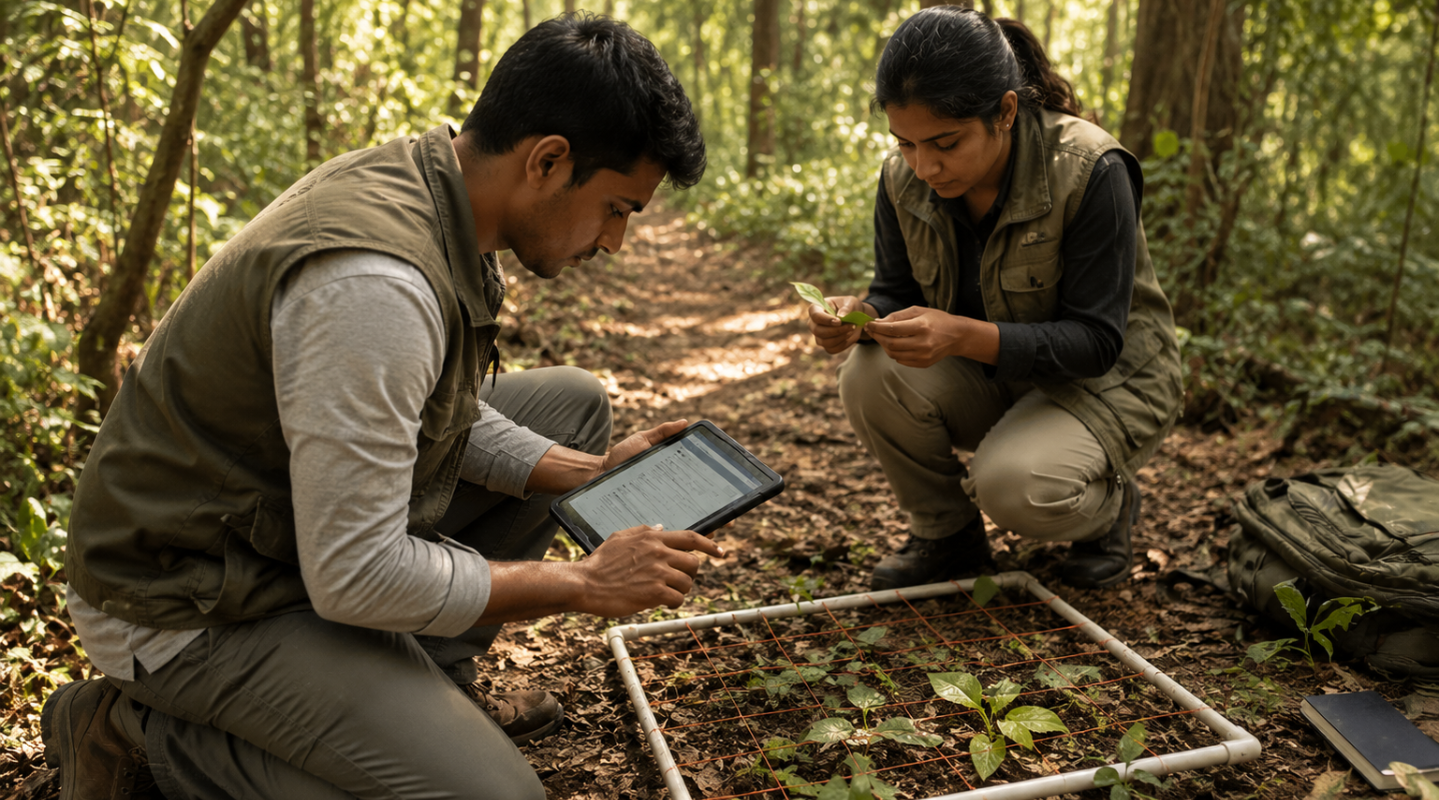
- Hands-on exposure to environmental research, field investigation, geospatial technologies and analytical methods.
- Access to edX through institutional membership, with opportunities to learn from leading universities and global institutions.
- Choose a Research Thesis, Applied Consultancy Project, or Sustainability Innovation Project in the final semester.
- Career preparation across climate action, environmental policy, ecological planning, conservation, environmental microbiology, sustainability communication, consulting, research and emerging sustainability sectors.
| Programme Details | |||
| Programme Name | M.Sc. in Environment and Sustainability (MSc ES) | Fees (2026-27) | INR 5,60,000/- per year |
| Duration | 2 Years (4 Semesters, Full Time) | Commencement | First week of September every year |
| Degree Awarded | Master of Science (M.Sc.) in Environment and Sustainability | School | School of Public Health, DY Patil University |
| Alignment | National Education Policy (NEP) 2020 and global sustainability priorities | Accreditation | NAAC A++, QS Rank – I Diamond |
| Focus Areas | Environmental science, Environmental health, policy, geospatial sciences, biotechnology, data analytics, sustainability planning | Specialisations | Choose 1 out of 6 specialisation pathways in Semester II |
| Computational Tools | R programming, environmental statistics, geoinformatics, environmental modelling | Emerging Fields | Wastewater-based surveillance, bioremediation biotechnology, carbon capture and storage |
| Capstone | Choose a Research Thesis, Applied Consultancy Project, or Sustainability Innovation Project under faculty supervision | Global Access | edX institutional membership with courses from leading universities |
| Eligibility | Bachelor’s degree in Environmental Science, Life Sciences, Architecture, Physical Sciences, Engineering, Public Health, Geography, Agriculture, Biotechnology, or related disciplines from a recognised university with an aggregate of 50% | Placement | Career service and placement support through the School of Public Health’s Career & Placement Cell |

Programme
Eligibility
Prospective candidates must have successfully completed a Bachelor’s degree in Environmental Science, Life Sciences, Physical Sciences, Engineering, Public Health, Geography, Architecture, Agriculture, Biotechnology, or any related discipline from a recognised university with a minimum aggregate of 50% marks (or equivalent grade).
Candidates with interdisciplinary academic backgrounds who demonstrate an interest in environmental sustainability, climate science, environmental policy, or environmental data analysis are encouraged to apply. Those who fall under the category of Foreign Nationals, Non-Resident Indians (NRI), or Persons of Indian Origin (PIO) should have completed an equivalent undergraduate degree examination from a recognised institution outside India.
Note: Admission of foreign nationals and NRIs shall be based on the prescribed University norms for international admissions. Admission cut-offs and dates change every cycle, so candidates should refer to the official DY Patil Deemed University admissions page before applying.
Program
Objectives
Master of Science in Environment and Sustainability (MSc ES) is a full-time postgraduate programme offered by the School of Public Health at DYPU. The curriculum of the programme is aligned with the vision of the National Education Policy 2020 and global sustainability priorities.
The programme is designed to develop professionals who can analyse environmental and sustainability challenges from scientific, social, economic, policy and technological perspectives. It recognises that climate change, biodiversity loss, pollution, resource depletion, urbanisation and environmental health are interconnected challenges that require interdisciplinary solutions.
Students develop the knowledge and practical competencies required to contribute to environmental consulting, sustainability and ESG, climate adaptation and mitigation, conservation and biodiversity management, environmental policy and governance, environmental health, urban sustainability, geospatial analysis, environmental monitoring, research and development.
Duration &
Pedagogy
2 Years | 4 Semesters | 80 Credits
Build a common foundation → choose a specialisation → gain field and professional experience → apply your learning through a thesis or applied project.
The programme follows a progressive, experiential learning model. Semester I establishes a common foundation in environment and sustainability. In Semester II, students choose one of six specialised pathways. Semester III centres on a mandatory Sustainability Field Lab and a career-oriented internship, while Semester IV is dedicated to a substantial thesis or practicum.
Learning is supported through:
- Interdisciplinary classroom learning and case-based discussion.
- Field immersion and environmental investigation.
- Research methods and evidence-based problem solving.
- Laboratory and practical learning where relevant to the chosen pathway.
- Geospatial, quantitative, qualitative and analytical approaches.
- Industry, government, NGO and research exposure through internships and engagement.
- Independent applied work through the final thesis or practicum.
edX Online
Courses
Students enrolled in the MSc ES programme are also provided access to the edX online learning platform through institutional membership with edX. The platform offers a wide range of courses delivered by leading universities and global institutions, enabling students to deepen their knowledge in specialised areas such as climate science, environmental data analytics, sustainability management, and environmental policy. This initiative allows students to learn from international experts, interact with a global community of learners, and supplement their classroom learning with cutting-edge knowledge and skills relevant to the rapidly evolving field of environment and sustainability.
Fees Structure
2026-27
Program Fee: ₹5,60,000 per year
Programme
Curriculum
| Semester I | Semester II | Semester III | Semester IV |
| Earth Systems and Planetary Boundaries | Specialisation Track (Choose 1 of 6): Option 01: Climate Change and Resilience; Option 02: Environmental Policy and Governance; Option 03: Green Infrastructure and Ecological Planning; Option 04: Conservation and Biodiversity; Option 05: Environmental Microbiology and Bioremediation; Option 06: Sustainability Communication and Behavioural Change | Sustainability Field Lab (Mandatory field immersion) | Thesis / Practicum (Choose any one) |
| Introduction to Sustainability Science | Research Methods – II | Career-Oriented Internship (Choose any one): Option 01: Sustainability Consultancy; Option 02: Entrepreneurship; Option 03: Education and Communication; Option 04: Policy and Diplomacy | Option 1: Research Thesis |
| Environmental Challenges in India | Option 2: Applied Consultancy Project | ||
| Environmental Governance, Law and Policy | Option 3: Sustainability Innovation Project | ||
| Research Methods – I | Elective | ||
| Microbial Diversity & Ecology | |||
| Behaviour Change for Sustainability |
Programme
Outcomes
Upon satisfactory completion of MSc Environment and Sustainability (MSc ES), graduates should be able to demonstrate the following outcomes.
| Programme Outcomes | |
| Advanced Environmental Knowledge | Demonstrate advanced understanding of environmental systems and the interactions among ecological, climatic, social, economic and built environments. |
| Quantitative and Computational Skills | Apply quantitative, statistical, and computational tools such as environmental statistics, data analytics, and R programming to analyse and interpret environmental data. |
| Geospatial and Assessment Tools | Use geospatial technologies and environmental assessment tools for environmental monitoring, ecosystem analysis, sustainability planning, and environmental impact evaluation. |
| Policy and Economic Evaluation | Evaluate environmental policies, laws, and economic frameworks to support evidence-based decision-making and sustainable environmental governance. |
| Interdisciplinary Research and Communication | Develop innovative, practical and context-specific solutions by integrating scientific knowledge, policy perspectives, stakeholder needs and sustainability principles. |
Programme
Scope
The MSc in Environment & Sustainability at DY Patil University prepares graduates for diverse and emerging careers across the environment and sustainability sector, with the flexibility to specialise according to their interests and career aspirations. Students can develop focused expertise in climate change and resilience, environmental policy and governance, green infrastructure and ecological planning, conservation and biodiversity, environmental microbiology and bioremediation, or sustainability communication and behaviour change. Through mandatory field immersion, career-oriented internships and applied learning, students gain experience in translating environmental knowledge into practical solutions.
Graduates can pursue opportunities in sustainability consultancy, environmental planning and management, conservation and biodiversity, environmental research, policy and governance, environmental communication and education, environmental microbiology and bioremediation, and sustainability-focused entrepreneurship, with pathways into government and regulatory organisations, consulting firms, NGOs, research institutions, development organisations and other sustainability-focused sectors. The programme also provides a strong foundation for students who wish to pursue research, doctoral studies or advanced academic careers in areas related to environmental science and sustainability.
Placement
Opportunities
Graduates of the MSc Environment and Sustainability (MSc ES) programme can explore diverse career opportunities across research, policy, industry, and international development sectors. The programme prepares graduates for specialised and leadership roles in environmental management, sustainability planning, and scientific research.
Potential placement opportunities and job roles include:
| Specialisation Area | Potential Job Roles | Employment Sectors |
| Climate Change and Resilience | Climate Change Analyst, Climate Risk Consultant, Sustainability Consultant, Carbon Accounting Specialist, Climate Adaptation Officer, ESG Analyst, Net-Zero Strategy Associate | Climate consultancies, ESG firms, sustainability divisions, renewable energy companies, development agencies, research organisations |
| Environmental Policy and Governance | Environmental Policy Analyst, Sustainability Advisor, Programme Officer, Environmental Governance Specialist, Development Consultant, Environmental Compliance Officer | Government departments, think tanks, policy institutes, NGOs, international organisations, environmental consultancies |
| Green Infrastructure and Ecological Planning | Environmental Planner, Ecological Planner, Sustainability Planner, Green Infrastructure Specialist, GIS Analyst, Urban Sustainability Officer, Landscape Planning Consultant | Urban planning agencies, smart city projects, consulting firms, infrastructure companies, environmental planning organisations |
| Conservation and Biodiversity | Conservation Officer, Biodiversity Specialist, Wildlife Programme Coordinator, Restoration Ecologist, Protected Area Manager, Biodiversity Assessment Consultant | Conservation NGOs, forest departments, wildlife organisations, biodiversity authorities, ecological restoration projects |
| Environmental Microbiology and Bioremediation | Environmental Microbiologist, Bioremediation Specialist, Water Treatment Specialist, Circular Bioeconomy Specialist, Environmental Surveillance Officer | Environmental laboratories, research institutions and universities, environmental consulting firms, remediation projects, industrial environmental management |
| Sustainability Communication and Behaviour Change | Sustainability Communications Officer, Environmental Educator, Behaviour Change Specialist, Community Engagement Coordinator, Sustainability Campaign Manager, Science Communication Professional | NGOs, CSR departments, sustainability organisations, media and communications agencies, educational institutions |
Key Recruitment Sectors
| Sector | Examples of Organisations |
| Government & Public Sector | MoEFCC, CPCB, SPCBs, Forest Departments, Biodiversity Boards, Municipal Corporations, Smart City Missions |
| Environmental Consulting | EIA Consultancies, Sustainability Advisory Firms, Environmental Engineering Firms |
| Corporate Sustainability & ESG | Sustainability and ESG divisions of corporations, CSR departments, renewable energy companies |
| Research & Academia | Universities, Research Institutes, Policy Think Tanks, Environmental Laboratories |
| NGOs & Development Organisations | WWF, WRI India, TERI, CEE, ATREE, Conservation India, Development Sector Organisations |
| International Organisations | UNEP, UNDP, WHO, UN-Habitat, IUCN, GIZ, World Bank-supported projects |
| Emerging Sustainability Sectors | Climate-tech startups, carbon management firms, nature-based solutions enterprises, circular economy ventures |
*Subject to meeting applicable academic and regulatory requirements.
Graduates may find employment in environmental consulting firms, sustainability divisions of corporations, governmental agencies, international organisations, research institutes, public health institutions, and non-governmental organisations working in the environment and sustainability sector.
Why Choose
DY Patil University for MSc Environment and Sustainability
- A multidisciplinary MSc housed within the School of Public Health, connecting environmental challenges with health, policy, communities and systems.
- Choose your professional direction through six clearly defined specialisation pathways.
- Learn through a progression from foundations to specialisation, field immersion, internship and an applied final project.
- Build practical skills in research, geospatial technologies, environmental assessment, analytical methods and sustainability problem solving.
- Gain professional exposure through a career-oriented internship with pathways in consultancy, entrepreneurship, education and communication, or policy and diplomacy.
- Learn from global resources through institutional access to edX courses from leading universities and institutions.
- Graduate with a portfolio of applied work through field immersion, internship experience and a thesis, consultancy project or sustainability innovation project.
- Prepare for diverse careers across government, consulting, ESG, climate, conservation, research, NGOs, international organisations and emerging sustainability enterprises.
- Strong computational training in R programming, environmental statistics, environmental modelling, and geoinformatics.
- edX institutional membership for global exposure to climate science, environmental data analytics, sustainability management, and environmental policy courses.
- Career pathways in environmental consulting, corporate sustainability and ESG, government agencies, international organisations, research institutes, public health, and NGOs.
FAQ's
- What is MSc Environment and Sustainability at DY Patil University and what is its scope?
- What is the eligibility for MSc ES at DY Patil University?
- What is the fee, duration, and format of MSc ES?
- Does the programme include research and field exposure?
- What career opportunities are available after MSc ES?
Contact us
