


Role of Allied Health Professionals in Patient Care: Building the Future of Healthcare Through Allied Health Sciences

Healthcare is more than just the diagnosis of illnesses or the administration of medical treatments. It provides support to patients in their recovery process and ensures independence and better quality of life.
Allied Health Professionals (AHP) play a significant role in the achievement of these tasks because they work closely with physicians, nurses and professionals in other fields of the healthcare industry.
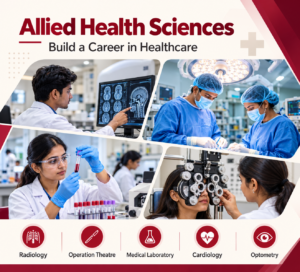
Allied Health Sciences is a growing sphere that offers many career options for students. The directions of the study include medical imaging, laboratory technology, operation theatre technology, dialysis technology, respiratory care, optometry, and physician assistant.
Understanding Allied Health Sciences and Its Importance
With time, healthcare has changed from a system where instead of a primary system it is taken over by doctors to modern healthcare, which engages specialists from several medical fields. Healthcare has evolved to understand that besides treatment, providing proper care consists of proper diagnosis, advanced technology assistance, rehabilitation when needed, varied forms of supervision, and preventive care.
Professionals in allied health contribute to healthcare by applying their knowledge and providing their skills. They support doctors in diagnosing health problems, using machines during treatment, assisting in surgical operations, monitoring patients, and providing various health care.
Thus, allied healthcare facilitates modern healthcare and offers a bright career for students who wish to work in the field of health care outside traditional medical professions.
Published on November 2, 2026
Importance of Allied Health Professionals in Patient Care
Allied Health Professionals contribute to patient care through various specialized roles.
1. Diagnosis and Medical Imaging
Radiology and medical imaging professionals use diagnostic devices like X-ray, CT, and MRI machines to take pictures that aid physicians in the diagnosis process. Their job helps facilitate successful diagnosis and therapy planning.
2. Laboratory Testing and Disease Detection
Medical laboratory technologists carry out tests on biological samples like blood and tissues. Their results allow physicians to discover diseases and monitor patients’ health status.
3. Operation Theatre and Anesthesia Support
Operation Theatre and Anaesthesia Technologists provide assistance to doctors during surgeries by preparing apparatus, ensuring sterile conditions, and assisting in anaesthesia-related procedures.
4. Dialysis and Kidney Treatment
Technologists employ and monitor dialysis equipment that offers treatment to kidney patients. Technologists support in administering treatment and keep an eye on the patient throughout the procedure.
5. Respiratory Treatment
Professionals dealing with respiratory treatment are trained to assist patients suffering from breathing-related disorders, such as respiratory distress. They support respiratory assessments and operations and assist patients with prescribed respiratory treatment.
6. Optometry and Eye Treatment
Professionals in the field of optometry help assess eyes and identify common vision problems. They also provide assistance in the room by conducting vision tests and identifying refraction errors, among others.
7. Role of a Physician Associate
Physician associates collaborate with physicians in various healthcare environments. They help in evaluating patients, updating medical records, performing clinical procedures and managing treatment according to what is permitted to them and in accordance with the supervision of an experienced physician.

Importance of Collaborative Care in Healthcare
In the healthcare sphere, teamwork among physicians is important for providing high quality healthcare services. Each specialist has a certain knowledge which is involved in the process of healing of patients.
Technology and the Future of Allied Health Sciences
The healthcare industry has undergone a major shift due to the introduction of innovations in technology. These technologies have made new opportunities for allied health practitioners. Innovative methods such as advanced diagnostic imaging systems, automated lab equipment, digital patient monitoring, artificial intelligence, and robotic technologies are changing the mode of healthcare services delivery.
Taking into account that the field of medical technology is evolving, it means that the necessity for qualified specialists will increase in the near future. It implies good prospects for a career in Allied Health Sciences.
Published on November 2, 2026
Education and Career Opportunities in Allied Health Sciences
Selecting the most suitable educational institution is important for a successful career in the field of healthcare. The students can choose from multiple options for undergraduate specialization in the health sector which will build the necessary skills and knowledge.
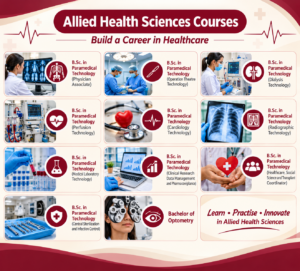
The programs involve such subjects as:
- B.Sc. in Paramedical Technology (Physician Associate)
- B.Sc. in Paramedical Technology (Operation Theatre Technology)
- B.Sc. in Paramedical Technology (Dialysis Technology)
- B.Sc. in Paramedical Technology (Perfusion Technology)
- B.Sc. in Paramedical Technology (Cardiology Technology)
- B.Sc. in Paramedical Technology (Radiographic Technology)
- B.Sc. in Paramedical Technology (Medical Laboratory Technology)
- B.Sc. in Paramedical Technology (Clinical Research Data Management and Pharmacovigilance)
- B.Sc. in Paramedical Technology (Healthcare, Social Science and Transplant Coordinator)
- B.Sc. in Paramedical Technology (Central Sterilization and Infection Control)
- Bachelor of Optometry
Using a combination of theoretical input, laboratory training, practical experience, and clinics helps the students to understand the significance of healthcare practice.
Professionals can seek work at medical centers, including hospitals, therapeutic and diagnostic laboratories, X-ray departments, operating rooms, and other organizations in the healthcare industry, depending on their area of focus and qualification.
Conclusion
Allied Health Sciences represent a key element in modern healthcare giving students a chance to participate in patient treatment through specific knowledge and technical skills. From diagnosing medical problems and assisting in surgical operations to laboratory tests and specialized treatment, allied health specialists help medical teams implement healthcare services.
Advances in digital health technologies and the growing demand for educated medical professionals lead to a wide variety of career prospects in this field.
Thus, it becomes clear that studying Allied Health Sciences allows students to begin their careers in the constantly developing healthcare area.
Published on November 2, 2026
Contact us
