


Nursing and Simulation Labs: Transforming Nursing Education Through Practical Learning

As healthcare is constantly evolving, nursing education is an important field which must change according to modern requirements. The role of nurses in patient care, emergency management, and healthcare operation is extremely important. Thus it is important to achieve good clinical skills, critical thinking abilities, and good communication skills in every nursing student.
Traditional classrooms can offer new theoretical knowledge in nursing, but students require practice to be ready for real-world situations. Nursing simulation laboratories are capable of meeting this challenge by creating a working environment in a safe and fully controlled environment.
Published on November 5, 2026
Published on November 5, 2026
What Is a Nursing Simulation Lab?
A nursing simulation lab is a specially designed learning space that recreates real hospital and healthcare settings, allowing students to practise nursing skills in a safe and controlled environment.Such centers can be included in hospitals, intensive care units, and emergency rooms. The labs offer various services such as the use of mannequins, medical equipment, role play method of training, and some digital technologies. These techniques are applied to help nursing students to acquire practical skills applicable in nursing practice.
Carrying out simulation education in nursing helps one to implement the knowledge acquired from education in practical situations that the student encounters during his/her work with patients. It provides an opportunity to practice several essential procedures, deal with emergency situations as well as to obtain the skills of patient care.
Through simulation education, students can repeat the same procedures, get feedback on their performances from teachers and improve their skills in the process of learning.
Importance of Simulation-Based Learning in Nursing Education
The use of simulation is important in the education of nursing students in terms of professional development. It acts as a bridge between theoretical training and practical work, thus making it possible to deliver patients safe and effective care.
The main advantages of nursing simulation labs are:
- Safety in learning: The students can perfect their skills and learn through mistakes without any negative influence on patients.
- Improvement in nursing skills: The repetition enhances skillful abilities of the individuals and increases the correctness of their activities.
- Critical thinking and decision-making: The simulated situations make the students learn how to evaluate symptoms and make the right decisions.
- Confidence: The process allows getting used to the clinical environment and thus alleviating anxiety before real surgical procedures.
- Communication skills: Nursing students learn to share ideas with patients and relatives, nursing staff, and other professionals.
Published on November 5, 2026
Types of Simulation Used in Nursing Labs
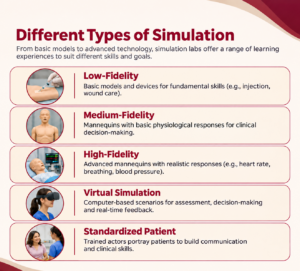
Different techniques are used in nursing simulation laboratories depending on the learning objectives and the complexity of the clinical skills that are being taught.
- Low-Fidelity Simulation
Low-fidelity simulation refers to the use of basic models and training devices for the instruction of basic nursing processes, including injection preparation, dressing of wounds and other rudimentary patient care skills.
- Medium-Fidelity Simulation
Medium-fidelity simulation includes the use of mannequins with selected physiological reactions in order to teach students how to assess patients and make basic clinical decisions.
- High-Fidelity Simulation
In high-fidelity simulation, sophisticated computerized mannequins are used to create realistic patient responses, such as changes in breathing, heartbeat, and blood pressure. The use of such simulation enables the learners to handle difficult clinical situations.
- Virtual Simulation
With the help of computer-based programs, the situations that occur in patient care are reproduced. The students perform patient assessment, make decisions and observe the results of their actions.
- Standardized Patient Simulation
In this approach, actors are professionally trained to portray patients with certain symptoms or diseases. In this situation, students learn how to communicate with patients and perform basic procedures.

Role of Nursing Simulation Labs in Clinical Skill Development
The simulation lab for nursing practices is an ideal place for acquiring several skills that are important in the medical field.
In such a laboratory, learners can practice procedures such as cardiopulmonary resuscitation (CPR), intravenous (IV) therapy, medication administration, wound dressing, taking vital signs, and assessing different patients with the help of the instructor.
Apart from the technical aspects of training, simulations play an important role in acquiring professional competencies including holding leadership positions, cooperating with others, and talking to patients and families.
Debriefing is another important part of this process. It refers to discussions held following the simulation and aimed at thorough examination of the actions performed and methods that should be improved in future.
Published on November 5, 2026
The Future of Nursing Simulation Labs
New possibilities are emerging in the field of nursing education due to innovations in technology. When virtual reality (VR) technologies are used, learners can experience exhilarating training situations in nursing, whereas AI-embedded simulations can generate personalized academic feedback and contextual scenarios that meet learners’ needs better.
New online solutions and electronic teaching tools contribute to the expansion of access to training in nursing. Technology will cause nursing simulation labs to be more dynamic and responsive to learners in the future.
Conclusion
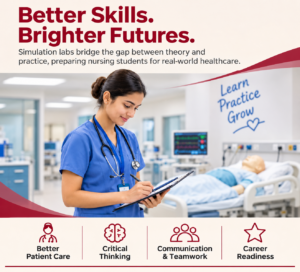
Simulation laboratories play an important role in education in the field of nursing through the connection of theory with hands-on training. In a teaching environment like this, students hone practical skills, thereby developing critical thinking and communication skills along with preparation for difficult situations in the sphere of healthcare.
The use of simulation techniques in nursing training is beneficial from the perspective of the formation of skilled, confident, and caring professionals in the area of nursing.
Published on November 5, 2026
Contact us
