


What Is Occupational Therapy? Understanding Its Role, Benefits, and Importance in Everyday Life

Occupational Therapy (OT) is one of the important parts of modern healthcare. It focuses on rehabilitation and improving the capability of a person to execute the usual day-to-day activities. The person may have physical, cognitive, sensory, or mental problems.
When a person has trauma, disease, surgery, or disability, he/she can be greatly in the execution of everyday activities like putting on clothes, eating, writing, cooking, and going back to work. Such difficulties can affect a person’s independence, productivity, and quality of life.
Occupational Therapy (OT) is a client-focused healthcare profession helping people achieve, sustain, and develop the skills necessary for their meaningful everyday life. With the help of evidence-backed therapeutic techniques, occupational therapists help people solve their activity limitations and improve their function to the level necessary for participation in all social and professional activities.
Published on November 3, 2026
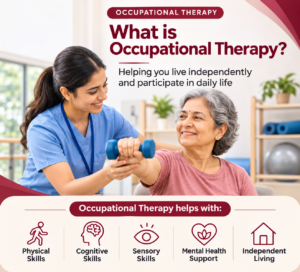
What Is Occupational Therapy?
Occupational therapy is a healthcare profession, which is focused on providing care to clients in ways that utilize their daily activities. During this activity, personal care, education, work, leisure time, and social participation are encountered.
The main purpose of this therapy is to make it possible for people to do what they want on their own despite some mental or physical abilities.
OT Professionals work to figure out what is possible for patients in their activities, determine what difficulties arise in performing different tasks, and prepare necessary programs for patients.

Importance of Occupational Therapy in Healthcare
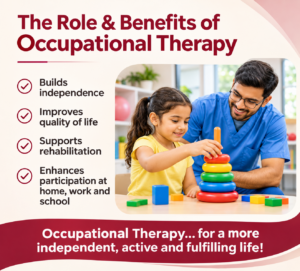
Occupational therapy plays an important role in rehabilitation and patient care. It helps people in overcoming functional limits and being more active in their lives.
The main advantages of occupational therapy include:
1. To Facilitate Independence in Daily Living
Occupational therapists teach individuals to perform daily activities such as bathing, dressing, eating, grooming, and writing.
2. Assisting Rehabilitation
People recovering from injuries, surgeries or neurological conditions may experience problems with moving, coordination and muscle strength.
3. Enhancing Cognitive and Psychological Status
Occupational therapy is also helpful for people experiencing cognitive and mental disorders. Memory, attention, problem-solving, emotional regulation and daily routines can be improved through performing different activities.
4. Helping Children with Developmental Problems
Children with developmental delays, autism spectrum disorders, learning disabilities or sensory processing disorders can utilize occupational therapy. Therapists use gaming techniques to improve fine motor skills, coordination, sensory processing and participation in school and everyday life.
5. Improving Participation at Work and in Community
Therapists work with the persons in regaining their access to jobs, schools, and other activities in the community after their sicknesses or injuries. Among their suggestions may be changes made in the workplace environment and improvement and providing people with mechanisms that simplify the accomplishment of various activities in their daily lives.
Published on November 3, 2026
Different Areas of Occupational Therapy
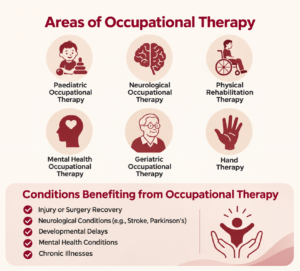
Occupational therapy includes various specialized fields such as:
Children’s Occupational Therapy
This part assists children in developing important motor skills, enhancing sensory processing, improving coordination, and fostering independence in daily activities.
Neurological Rehabilitation
This helps individuals who are recovering from strokes, traumatic brain injuries, spinal cord injuries, and various neurological disorders.
Physical Rehabilitation
This therapy works with individuals to enhance movement, coordination, strength, and overall functional abilities after experiencing injuries or surgical procedures.
Mental Health Occupational Therapy
This provides support for individuals facing mental health challenges by helping improve their daily routines, encouraging social participation, aiding emotional regulation, and promoting independent living skills.
Geriatric Occupational Therapy
This therapy focuses on supporting older adults to maintain their independence while addressing age-related functional limitations and ensuring they can safely complete daily tasks.
Hand Therapy
This therapy concentrates on restoring function in the hands and upper limbs following injuries, surgeries, or medical conditions.
Who Can Benefit from Occupational Therapy?
Occupational therapy is used for all ages. It is specially useful for people who need help in their daily activities because of:
- Stroke and neurological diseases.
- Arthritis and musculoskeletal conditions.
- Spinal cord injuries and traumatic brain injury.
- Old age problems.
- Developmental disorders and autism spectrum disorders.
- Mobility problems due to illness or disability.
- Mental illness.
- Recovery after surgery or serious illness.
Published on November 3, 2026
Role of an Occupational Therapist
Occupational therapists are practitioners that help patients in improving their functional skills and independence. Their work include evaluation, identification of issues, planning of treatment modalities, applying therapies, and tracking changes.
Occupational therapists also cooperate with physicians, physiotherapists, psychologists, nurses, and other specialists while taking care of patients.
Education and Career Opportunities
Occupational therapy is an option for students keen on pursuing a career in the field of healthcare and rehabilitation. Occupational therapy provides students with basic knowledge of anatomy, physiology, psychology, human growth and development, rehabilitation methods, and therapy methods. The profession also involves theoretical studies combined with practical training and clinical practice.
The degree in occupational therapy provides the following career opportunities:
- Medical and rehabilitation facilities.
- Child therapy institutions.
- Mental health institutions.
- Special schools.
- Geriatric institutions.
- Community healthcare centers.
- Universities and research institutions.
- Private clinics of occupational therapy.
Conclusion
Occupational therapy is a leading segment of the modern healthcare industry, helping in independence of patients and encouraging them to engage in daily activities. The implications of occupational therapy can be seen on every life stage.
Occupational therapy applies the principles of its practice to equally address different age-related conditions from children’s development issues to injuries in adulthood and aged people’s independence maintenance.
Through concentrating on the importance of activities involved, personalized approaches to rehabilitation, and holistic care, occupational therapists assist people in achieving their desired outcomes.
Published on November 3, 2026
Contact us
