

BSc Optometry vs BSc MLT: Comparing Two Popular Allied Health Careers
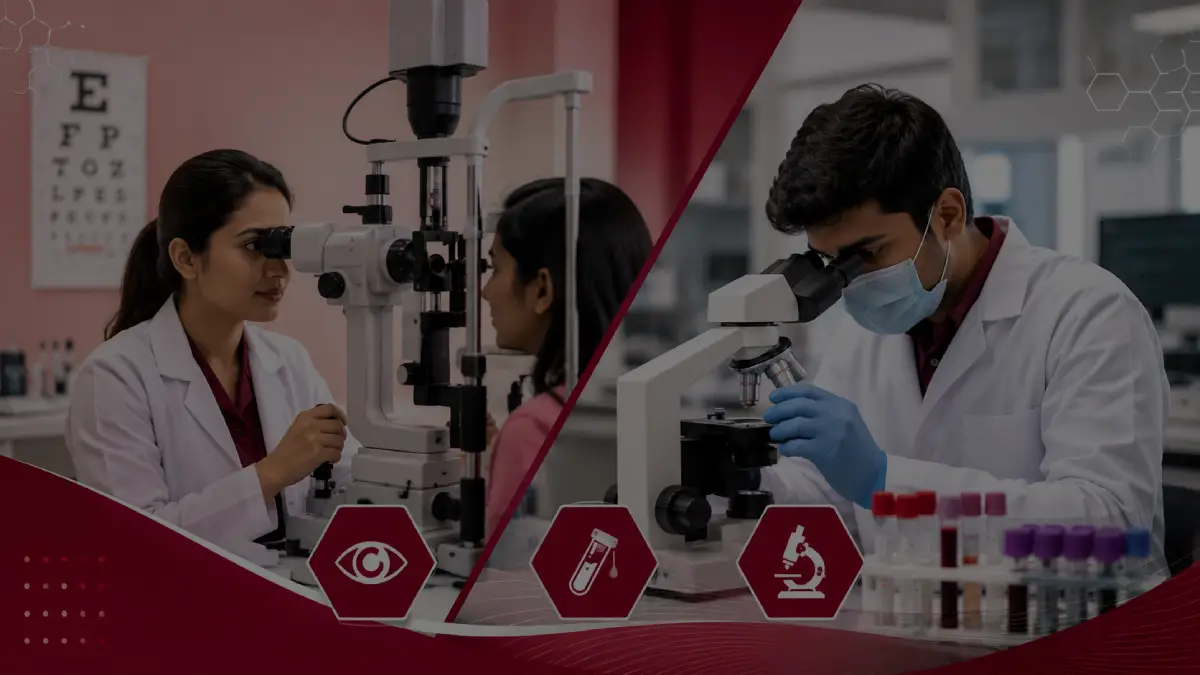
Choosing between two healthcare courses that both begin with a B.Sc. and both promise a job inside a hospital can feel genuinely confusing. That’s exactly where most 12th Science students land when they sit down to weigh BSc Optometry vs BSc MLT. On paper, the two look like cousins — same eligibility, similar duration, the same allied health family. In real life, they send you down very different roads. One puts you face-to-face with patients, checking eyesight and fitting glasses. The other puts you behind a bench, running the blood and tissue tests that doctors lean on to diagnose disease.
This guide walks through the decision the way an experienced counsellor would: course content, salary, job demand, day-to-day work, and where each path can take you in five or ten years. By the end, you will know which path genuinely fits the work you want to do — and why.
BSc Optometry trains you as a primary eye-care professional — you examine vision, prescribe lenses, and screen for eye disease in a patient-facing role. BSc MLT (Medical Laboratory Technology) trains you to run diagnostic tests on blood, tissue, and other samples in a lab-based role. Both are three-year undergraduate degrees with strong demand. Optometry suits people who enjoy direct patient interaction; MLT suits those who prefer precise, behind-the-scenes diagnostic work.
Know More: B.Sc. MLT Course Details 2026: Colleges, Fees, Eligibility and Career Scope in India
What is the difference between optometry and MLT?
The simplest way to understand this question is to look at who you spend your day with. An optometrist spends their time with patients who walk in worried about blurry vision, and you help them see clearly again. A medical lab technologist spends their time with samples that is a vial of blood arrives, and you turn it into a report a doctor can act on. Both are essential. Both keep healthcare running. They just sit at opposite ends of the patient journey.
This is really the heart of the eye care vs lab work choice, and it’s also the patient-facing vs diagnostic roles choice rolled into one. Let’s look at what each graduate actually does.
What does a B.Sc. Optometry graduate do?
A Bachelor of Optometry trains you to work as an optometry technologist. After grounding in basic medical sciences, you learn to measure eyesight, prescribe corrective lenses, and detect eye diseases. You also assist eye specialists during examinations, fit and maintain contact lenses, prepare and repair spectacles, and keep patient records in order. Graduates find work in eye clinics, optician showrooms, the contact-lens and ophthalmic-lens industry, hospital eye departments, and optical retail chains.
What does a BSc MLT graduate do?
A B.Sc. in Medical Laboratory Technology trains you to work as a medical laboratory technician. You learn to collect, store, and transport biological samples, then process them on a range of machines and prepare reports under expert supervision. The course also covers blood-bank management, materials and supply-chain handling, laboratory information systems, equipment maintenance, and biomedical waste management. Graduates work across the pathology, biochemistry, and microbiology departments of hospitals, diagnostic centres, and clinics.
Know More: BPH Course Details 2026: Eligibility, Fees, Syllabus and Duration
BSc Optometry vs BSc MLT at a glance
| Aspect | BSc Optometry | BSc MLT |
|---|---|---|
| Core focus | Vision and eye health | Disease diagnosis through lab testing |
| You work with | Patients (live, in person) | Samples (blood, tissue, fluids) |
| Role type | Patient-facing, clinical | Diagnostic, behind-the-scenes |
| Typical workplace | Eye clinics, optical showrooms, and hospital eye departments | Pathology labs, diagnostic chains, hospital labs |
| Signature skill | Refraction and prescribing lenses | Running and interpreting diagnostic tests |
| Best fit personality | Communicative, people-oriented | Detail-oriented, methodical |
B.Sc. Optometry vs B.Sc. MLT: course structure, eligibility, and fees
Here’s where the two courses look almost identical — which is part of what makes this choice so tricky. At DY Patil University’s School of Allied Health Sciences in Navi Mumbai, both are three-year undergraduate degrees followed by a one-year hospital internship, both require the same school background, and both currently carry the same annual fee. The table below lays it out.
| Parameter | B.Sc. Optometry | B.Sc. MLT |
|---|---|---|
| Duration | 4 years + 1 year internship | 3 years + 1 year internship |
| Internship | Non-stipendiary, at DY Patil Hospital, Nerul, Navi Mumbai | Non-stipendiary, at DY Patil Hospital, Nerul, Navi Mumbai |
| Eligibility | 12th Science with Physics, Chemistry, Biology | 12th Science with Physics, Chemistry, Biology |
| Indicative fee (2026–27)* | INR 2,00,000 per year | INR 2,00,000 per year |
| Award | Bachelor of Optometry | B.Sc. in Paramedical Technology (MLT) |
*Fee figures change every admissions cycle and are regulated. Always confirm the current fee with the DY Patil admissions office before relying on it.
Know More: What Is Information Technology? Definition, Types, Components, and Careers Explained
Which course has a higher salary?
This is often the first question students and parents ask, so let us address it directly. At the fresher stage, salaries for both courses sit in a similar band; there is no dramatic gap that should decide the matter on its own. Where the paths diverge is later, once you specialise and choose your sector. Optometry rewards those who move into private practice or premium corporate optical chains. MLT rewards those who progress into specialised diagnostics or take up roles abroad, particularly in the Gulf.
The figures below are indicative ranges drawn from multiple Indian salary and career sources for 2025–26. Treat them as a guide, not a promise. Actual pay swings widely with city, employer, skill, and whether you’re in a government or private setup.
| Career stage | BSc Optometry (per year) | BSc MLT (per year) |
|---|---|---|
| Fresher/entry level | ≈ ₹2.5 – 4 lakh | ≈ ₹2.5 – 4 lakh |
| 3–5 years’ experience | ≈ ₹4 – 6 lakh | ≈ ₹4 – 8 lakh |
| Senior / specialist | ₹8 lakh and above (private practice can exceed ₹12 lakh) | ₹8 – 15 lakh in molecular/specialised diagnostics |
| Biggest upside | Owning a private practice or optical retail role | Specialised diagnostics, lab management, overseas roles |
So if you were hoping BSc Optometry vs BSc MLT had one obvious higher-paying winner, the honest verdict is that earning potential depends far more on what you do after the degree than on the degree itself. Choose the field whose daily work you will enjoy, then specialise. Specialisation is what most strongly influences long-term earnings.
Which has better job demand?
Encouragingly, both fields face a shortage of trained professionals, so neither of the fields leaves graduates struggling to find work. The reasons behind that demand, however, differ.
Demand for optometrists
India has a serious eye-care gap. Roughly 550 million Indians need spectacles; the country carries more than a fifth of the world’s blind population, and a national AIIMS survey has flagged an acute shortage of eye-care professionals, especially outside the big cities. Estimates suggest India needs well over 98,000 allied ophthalmic personnel just to meet basic eye-care needs. That’s not a temporary blip — it’s a structural shortage that will keep optometry hiring strong for years.
Demand for medical lab technologists
MLT demand rides on India’s rapidly growing diagnostics industry. Every hospital, nursing home, and clinic needs a functioning laboratory, and leading diagnostic chains such as Dr. Lal PathLabs, Metropolis, Thyrocare, and SRL Diagnostics are expanding quickly, alongside newer home-collection and AI-assisted pathology platforms. The pandemic permanently raised public awareness of diagnostic testing, and that demand has not receded. Qualified laboratory technologists are rarely short of opportunities.
Bottom line on demand: both fields score high. Optometry’s demand is concentrated in eye care and is especially acute in semi-urban and rural India; MLT’s demand is spread across the entire diagnostics ecosystem. Where you live and want to work matters more than which field is “hotter.”
Which suits patient-facing roles?
If you are energised by interacting with people and solving their problems in real time, optometry is the clearer fit. You will spend your day in conversation, understanding symptoms, conducting the eye test, explaining the result, and providing a solution the patient can immediately see working. This is eye care vs lab work in its most direct sense.
MLT calls for the opposite temperament. The work is precise, focused, and largely out of public view. Your subject is usually a labelled sample, and your satisfaction comes from accuracy — from knowing that your report helped a doctor reach the right decision. Neither role is superior; they simply reward different strengths. For many students, this patient-facing vs diagnostic roles distinction is the single most useful lens for the entire decision.
| Day-to-day | BSc Optometry | BSc MLT |
|---|---|---|
| People contact | High — constant patient interaction | Low — mostly sample-based work |
| Environment | Clinic, showroom, OPD | Laboratory, controlled and quiet |
| Communication load | Heavy — counselling and explaining | Light — reporting and documentation |
| Reward signal | A patient who can see clearly | An accurate, timely report |
What are the further study options after each course?
Both degrees are launchpads rather than dead ends, and your further study options are genuinely broad on either side. A bachelor’s degree is sufficient to begin working, but a master’s is what unlocks the higher salary bands and specialist roles described earlier.
After a BSc in Optometry, you can pursue:
- Master of Optometry (M.Optom) / M.Sc. Optometry
- Specialisations such as contact lens practice, low-vision rehabilitation, paediatric optometry, or sports vision
- Hospital management or public-health routes, and eventually a PhD for academic and research careers
After BSc MLT, you can pursue:
- M.Sc. in Medical Laboratory Technology
- Specialisations such as molecular diagnostics, histopathology, cytogenetics, microbiology, or immunology
- MBA in Hospital or Healthcare Management for lab-leadership roles, or a PhD for research
DY Patil University offers postgraduate pathways in both streams — a Master of Optometry and an M.Sc. in Medical Laboratory Technology — so you can complete your entire journey, undergraduate through postgraduate, on one campus.
BSc Optometry vs BSc MLT: pros and cons
No course is without trade-offs. The balanced view below will help you decide with full clarity.
BSc Optometry — pros and cons
| Pros | Cons |
|---|---|
| Strong, structural demand for eye-care professionals | A patient-facing role can be tiring for introverts |
| Clear path to independent private practice | Retail-linked roles may involve sales targets |
| Direct, visible impact on patients | Growth often needs a master’s or specialisation |
BSc MLT — pros and cons
| Pros | Cons |
|---|---|
| Demand across every hospital and diagnostic lab | Limited patient interaction may feel isolating |
| Strong overseas scope, especially in the Gulf | Shift work and exposure to biological samples |
| Clear specialisation ladder in advanced diagnostics | Entry pay can be modest before you specialise |
Which course should I choose?
There’s no universal winner here — there’s only the one that fits you. Instead of giving you a single verdict, here are two honest options to match against your own temperament:
Lean towards BSc Optometry if:
- You enjoy talking to people and want a visibly patient-facing role
- You like the idea of one day running your own practice
- Eye care, vision, and clinical interaction excite you more than lab machines
Lean towards BSc MLT if:
- You prefer precise, focused, behind-the-scenes work
- You’re drawn to diagnostics, pathology, and problem-solving with data
- You want strong overseas options and a clear specialisation ladder
Still undecided? Consider shadowing a professional in each field for a day, or speak with a course counsellor before committing. The allied health course comparison that matters most is not on paper; it is the choice between the two kinds of working days you can realistically picture yourself enjoying for the next decade.
Why study allied health sciences at DY Patil University?
Whichever side of this decision you land on, where you study shapes how employable you are. DY Patil University’s School of Allied Health Sciences in Navi Mumbai builds both programmes around a teaching hospital, so your one-year internship happens inside a live clinical setting rather than a simulation. You train on real equipment, alongside working professionals, with a dedicated placement cell supporting your transition into the workforce.
- Hospital-integrated learning — internships run at DY Patil Hospital, Nerul, Navi Mumbai
- Modern labs and clinical infrastructure — hands-on training across well-equipped facilities
- Dedicated placement support — career-service cells tailored to each programme
- Postgraduate continuity — master’s options in both optometry and MLT on the same campus
You can explore both programmes in detail on the official pages — the Bachelor of Optometry and the B.Sc. in Medical Laboratory Technology — or browse the full School of Allied Health Sciences.
Frequently asked questions
Is B.Sc. Optometry better than B.Sc. MLT?
Neither is universally better. B.Sc. Optometry is the stronger fit if you want a patient-facing eye-care role, while B.Sc. MLT suits you better if you prefer diagnostic, lab-based work. The right choice depends on your personality and the kind of working day you want.
Which has a higher salary, optometry or MLT?
At the fresher level, both sit in a similar range, roughly ₹2.5–4 lakh per year. Long-term earnings depend more on specialisation and sector than on the course itself — optometry rewards private practice, while MLT rewards advanced diagnostics and overseas roles.
Which course has better job demand in India?
Both have strong demand. India faces a structural shortage of eye-care professionals, keeping optometry hiring strong, while a fast-growing diagnostics industry keeps demand high for medical lab technologists across hospitals and labs.
Can I do a master’s after BSc Optometry or BSc MLT?
Yes. Optometry graduates can pursue a Master of Optometry, and MLT graduates can pursue an M.Sc. in Medical Laboratory Technology, along with various specialisations. DY Patil University offers postgraduate options in both.
What is the eligibility for BSc Optometry and BSc MLT at DY Patil?
Both require 12th Science with Physics, Chemistry, and Biology. Both are three-year undergraduate programmes with a one-year hospital internship.
Which course is more patient-facing?
BSc Optometry is far more patient-facing — you interact directly with patients all day. BSc MLT is largely behind-the-scenes diagnostic work, where most of your time is spent with samples rather than people.
Final thoughts
Strip away the noise, and the BSc Optometry vs BSc MLT decision comes down to a single honest question: do you want to spend your career working with patients or with samples? Optometry offers a clinic, direct interaction, and the satisfaction of helping someone see clearly. MLT offers a laboratory, analytical precision, and the quiet assurance of getting a diagnosis exactly right. Both are respected, both are in demand, and both can grow into well-paid, specialised careers. Choose the daily work you can see yourself committing to, study it somewhere that places you inside a real hospital, and the rest tends to follow.
Published on July 18, 2026
Contact us
