

BPH Course Details 2026: Eligibility, Fees, Syllabus and Duration
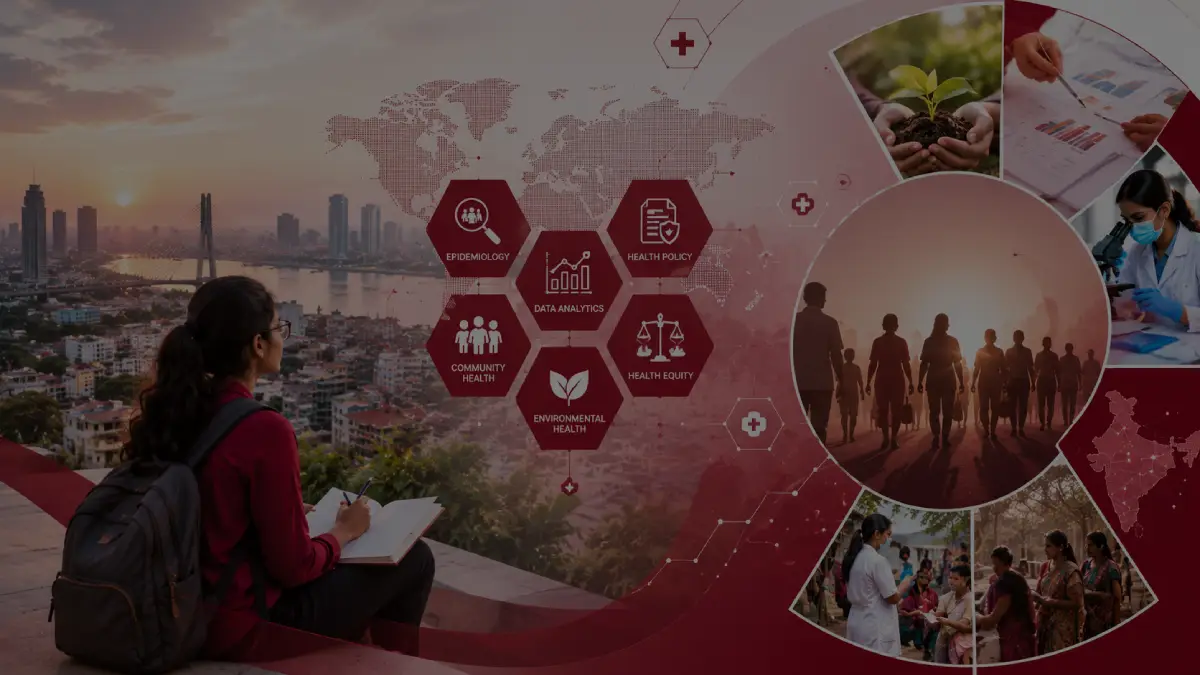
The Bachelor of Public Health (BPH Hons.) at DY Patil University School of Public Health is a four-year, full-time NEP 2020-aligned degree of 160 credits across eight semesters. Eligibility requires 10+2 in any stream with 50 percent aggregate marks. The 2026-27 tuition fee is INR 5,00,000 per year. The syllabus covers epidemiology, biostatistics, environmental health, research methods, and health policy, with internships and a capstone practicum. Graduates work as epidemiologists, health analysts, administrators and policy consultants across government, NGOs and health tech.
What Is the BPH Course?
The Bachelor of Public Health (BPH) is an undergraduate programme that focuses on promoting health, preventing diseases, and improving the well-being of communities. It is an interdisciplinary field that combines knowledge from health sciences, social sciences, statistics, management, and public policy to address public health challenges at the population level. Unlike clinical healthcare programmes that focus on treating individual patients, BPH emphasises disease prevention, health education, health promotion, and the development of effective healthcare systems.
Students gain knowledge in subjects such as epidemiology, biostatistics, environmental health, health communication, research methods, and health policy. The programme also includes practical learning through fieldwork, internships, and community-based projects, enabling students to apply theoretical concepts to real-world situations. Graduates can pursue careers in government health agencies, NGOs, hospitals, research organisations, and health-tech companies, or continue their studies through postgraduate programmes in public health and related disciplines.
Know More: Bachelor of Public Health Course in Mumbai
What are the Eligibility Criteria for BPH?
| Requirement | Criteria |
|---|---|
| Academic qualification | Successful completion of 10+2 or an equivalent examination in any stream from a recognised educational board. |
| Minimum aggregate | A minimum of 50 percent aggregate marks, or the equivalent grade, in the qualifying examination. |
| International applicants | Foreign National, Non-Resident Indian (NRI), or Person of Indian Origin (PIO) candidates must have completed an equivalent grade examination from a recognised international board or university outside India. |
Because the criteria are open to any stream, candidates from science, commerce, and humanities backgrounds can all apply if they meet the 50 percent aggregate requirement.
Know More: Public Health Courses After 12th
What Is the BPH Course Duration and How Do NEP 2020 Exit Options Work?
The BPH is a comprehensive four-year, full-time course of 160 credits spread across eight semesters, with the academic year commencing in the first week of July. The pedagogy prioritises experiential learning, integrating classroom discussions with mandatory internships, field assignments, and research projects.
| Attribute | Detail |
|---|---|
| Degree awarded | Bachelor of Public Health (BPH Hons.) |
| Duration | 4 years, full-time |
| Credits | 160 credits |
| Structure | 8 semesters |
| Policy alignment | National Education Policy (NEP) 2020 |
| Intake commences | First week of July |
As an NEP 2020-aligned four-year honours degree, the programme sits within the University Grants Commission Curriculum and Credit Framework for Undergraduate Programmes (CCFUP), which provides multiple entry and exit points. Under that national framework, students earn progressively higher awards based on the number of years and credits completed, and those who exit early may re-enter within three years, with a total completion window of seven years.
Know More: Best Public Health Colleges in Mumbai
Certificate, Diploma, Degree, and Honours with Research: How Do the Exit Awards Work?
The table below summarises the standard NEP 2020 and UGC CCFUP exit awards for a four-year honours pathway. The four-year, 160-credit honours structure of the BPH corresponds to the final stage of this framework.
| Stage | NEP 2020 / UGC framework award |
|---|---|
| After Year 1 (2 semesters) | Undergraduate Certificate |
| After Year 2 (4 semesters) | Undergraduate Diploma |
| After Year 3 (6 semesters) | Bachelor’s Degree |
| After Year 4 (8 semesters, 160 credits) | Bachelor’s Degree with Honours, or Honours with Research |
These award stages are defined by the national NEP 2020 and the UGC Curriculum and Credit Framework for Undergraduate Programmes. Under this framework, students who exit early may re-enter within three years, and the total period to complete the degree does not exceed seven years.
What Does the BPH Syllabus Cover?
The BPH curriculum is designed to build a strong foundation in public health theory, research, and practice. Key areas of study include:
- Scientific foundations for health – understanding the biological, social, and population sciences that underpin public health.
- Health promotion and communication – learning how to encourage healthy behaviours and design effective public health interventions.
- Environment and health – examining how environmental, social, and developmental factors influence health outcomes.
- Health systems and policy – understanding how healthcare systems operate and how public health programmes are designed and implemented.
- Epidemiology and population health – studying disease patterns, risk factors, infectious diseases, and the social determinants of health.
- Research and data analysis – developing skills in statistics, quantitative and qualitative research methods, and evidence-based decision-making.
- Technical and digital public health tools – gaining exposure to GIS mapping, health informatics, health data management, and Python-based analytical applications.
- Specialised public health topics – exploring areas such as nutrition, sexual and reproductive health, climate and disaster preparedness, health economics, and bioethics.
- Practical and professional development – applying knowledge through fieldwork, internships, leadership training, and a capstone project or public health practicum.
Together, these areas equip students with the analytical, technical, and practical skills needed to understand and address contemporary public health challenges.
What Are the Core Subjects: Epidemiology, Biostatistics, and Environment & Health?
Three subject pillars define the analytical strength of a public health graduate. Epidemiology teaches students to identify disease determinants and measure how health and illness are distributed across populations, progressing through Infectious Disease Epidemiology and Social Epidemiology. Biostatistics, built through the Foundations of Statistics sequence and tools such as Python for machine learning, equips students to analyse population-level data and support evidence-based decisions.
Environment & Health, a core theme running through multiple semesters, explores the relationship between environmental, social, and ecological factors and population health outcomes. Students examine issues such as environmental determinants of health, sustainability, climate-related health risks, and disaster preparedness, developing an understanding of how environmental conditions influence community wellbeing. This knowledge provides an important foundation for later study in research methods, health systems, policy development, and data-driven public health practice.
What Is the BPH Course Fee Structure?
The published tuition fee for the 2026-27 admission cycle is set out below.
| Student Category | Tuition Fee Per Year |
|---|---|
| Indian nationals | INR 5,00,000 |
What Is the BPH Admission Process and Which Documents Are Required?
Admission is open to candidates who meet the eligibility criteria of 10+2 in any stream with a minimum of 50 percent aggregate marks. Prospective students can begin the process by submitting an enquiry or application through the official Bachelor of Public Health programme page, or by contacting the admissions team using the numbers listed at the end of this document. For the current application steps, deadlines, and the document checklist, applicants should refer to the official DY Patil University admissions page.
How Do Internships and Field Training Work in the BPH Programme?
Experiential learning is built into the degree through the curriculum rather than added separately. Students undertake structured fieldwork in the second year, complete a one-month internship in the third year, and conclude with a capstone project and public health practicum in the final semester. To support this, the School maintains strategic partnerships with leading national and international healthcare organisations and public health institutes, providing students with global exposure.
| Stage | Applied learning component |
|---|---|
| Year 2, Semester 3 | Experiential learning through structured fieldwork |
| Year 3, Semester 6 | Internship of one month |
| Year 4, Semester 8 | Capstone project and public health practicum |
What Are the Career Outcomes After a BPH Degree?
The interdisciplinary nature of the BPH positions graduates for diverse roles across sectors in India and globally, ranging from data-focused analytical work to community-focused leadership. Representative roles include public health analysts, health educators, epidemiologists, healthcare administrators, and policy consultants. The sectors that recruit BPH graduates are summarised below.
| Sector | Example opportunities |
|---|---|
| Public sector and government | National health missions, municipal corporations, and state health departments |
| Non-governmental organisations | Leadership and field roles in bodies such as WHO, UNICEF, and PATH, as well as domestic non-profits |
| Corporate healthcare and insurance | Corporate social responsibility, wellness programme management, and health insurance analytics |
| Research and academia | Research assistantships in clinical trials, population studies, and data-driven health institutes |
| Health tech and startups | Consulting and operational roles in digital health, telemedicine, and health informatics |
Through the programme, students develop epidemiological analysis, biostatistics and data skills, research methodology, health communication, policy design, and leadership. The degree also serves as a recognised foundation for a Master of Public Health (MPH), or for advanced study in healthcare management, health policy, or epidemiology, opening pathways to senior leadership and academic research.
Know More: Career Scope After Bachelor of Public Health in India
Frequently Asked Questions
What is the full form of BPH?
BPH stands for Bachelor of Public Health. It is an interdisciplinary undergraduate degree focused on population health, epidemiology, biostatistics, environmental health, and health policy.
What is the duration of the BPH course at DY Patil University?
The BPH Hons. is a four-year, full-time programme of 160 credits across eight semesters, aligned with NEP 2020.
What is the eligibility for the BPH programme?
Applicants need to have completed 10+2 or an equivalent examination in any stream from a recognised board with a minimum of 50 percent aggregate marks.
Can commerce or arts students apply for BPH?
Yes. The eligibility criteria accept candidates from any stream, so students from science, commerce, and humanities backgrounds can all apply if they meet the 50 percent aggregate requirement.
What is the BPH course fee at DY Patil University?
The tuition fee for 2026-27 is INR 5,00,000 per year for Indian nationals.
What is the basis of BPH admission?
The published eligibility is based on a 10+2 qualification in any stream with a minimum of 50 percent aggregate marks. Applications and enquiries are made through the official programme page or the listed admissions contact numbers.
What are the NEP 2020 exit options?
Under the national NEP 2020 and UGC framework that this four-year honours degree aligns with, students earn a certificate after one year, a diploma after two years, a bachelor’s degree after three years, and an honours or honours with research degree after the full four years.
What subjects are taught in the BPH syllabus?
Core subjects include epidemiology, biostatistics, environmental health, research methods, health systems, health economics, public health nutrition, health informatics, and a capstone practicum.
Does the BPH include internships?
Yes. The BPH programme includes a dedicated internship semester in the fourth year. Students are also supported by the Career and Placement Cell, which provides career training and facilitates internship opportunities through the school’s network of partner organisations and institutions.
What jobs can graduates pursue after a BPH degree?
Graduates work as public health analysts, health educators, epidemiologists, healthcare administrators, and policy consultants across government, NGOs, corporate healthcare, research, and health tech.
Can a student pursue an MPH after a BPH?
Yes. The BPH is a recognised foundation for a Master of Public Health (MPH) and for advanced study in healthcare management, health policy, epidemiology, and related fields. Students at the School also have the option to pursue an Integrated MPH pathway, allowing them to continue after completing their BPH (Honours) degree and earn their MPH with just one additional year of study, providing an accelerated route to postgraduate qualification.
When does the BPH academic year begin?
The programme commences annually in the second week of September.
Where is the DY Patil University School of Public Health located?
Located in the Centre of Excellence Building, DY Patil deemed to be University is at Sector 7, Nerul, Navi Mumbai 400706.
Does the BPH offer specialisations?
Yes. Through choice-based electives and disciplinary minors, students can specialise in areas such as Gender and Health, Health Technology Assessment, and Environmental Health.
Published on June 23, 2026
Contact us
