

MBA in Hospital and Healthcare Management: Career Opportunities in the Post-Pandemic Era

The pandemic changed everything about how hospitals work. From oxygen logistics and ICU expansion to digital triage, telemedicine, and real-time bed dashboards, healthcare delivery in India became a high-stakes management problem almost overnight. Five years on, the demand for trained healthcare managers has not slowed down. It has multiplied.
If you are a student or a parent looking at long-term career security, an MBA in Hospital and Healthcare Management is one of the most relevant choices in 2026. The sector is growing fast, salaries are climbing, and many of the roles available today did not even exist before COVID-19.
How the Pandemic Reshaped Healthcare Management in India
Before 2020, hospital administration was largely about beds, billing, and basic operations. The pandemic forced a complete redesign. Hospitals had to manage resource scarcity at scale, switch overnight to digital workflows, coordinate with government command centres, run public communication, and rebuild trust with patients.
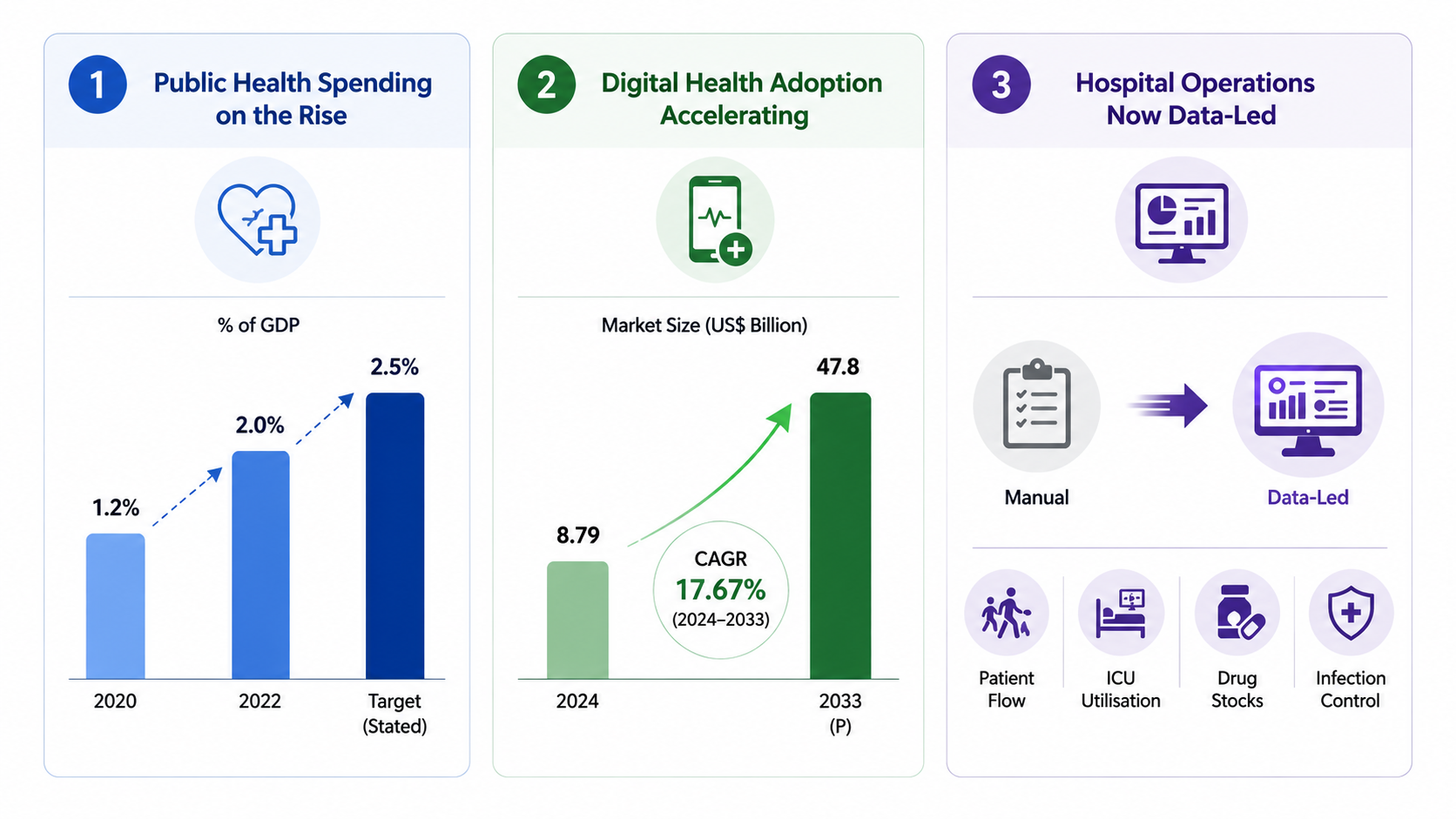
Three structural shifts followed:
- Public health spending in India rose from about 1.2 percent of GDP in 2020 to about 2 percent of GDP in 2022, with a stated target of 2.5 percent according to the Economic Survey, via IBEF.
- Digital health adoption moved from a side project to a core function. The Indian digital health market was valued at around US$8.79 billion in 2024 and is projected to reach close to US$47.8 billion by 2033, growing at a CAGR of 17.67 percent, according to the IBEF Healthcare.
- Hospital operations became data-led. Patient flow, ICU utilisation, drug stocks, and infection control are now monitored through dashboards rather than paper registers.
The result is a permanent shift in what hospital boards expect from their managers.
Why Hospital and Healthcare Management Is a High-Demand Career Now
Several verified data points make the career case clear.
1. India faces a serious health workforce gap
According to the World Health Organization, India needs at least 1.8 million additional doctors, nurses, and midwives to meet basic healthcare demand. A peer-reviewed scoping review (PMC, 2024) also estimates that India will need more than 11,000 additional health management professionals by 2030 to maintain a healthy ratio of 2.97 health managers per 100,000 population.
2. The hospital industry is growing fast
India’s hospital sector was valued at about US$98.98 billion in 2023 and is projected to reach close to US$193.59 billion by 2032, growing at a CAGR of around 8 percent (Credence Research).
3. Medical tourism is back and bigger
India is among the world’s top medical tourism destinations. The sector was valued at around US$7.69 billion in 2024 and is expected to nearly double to US$16.21 billion by 2030, growing at a CAGR of 13.23 percent according to coverage by Business Standard, 2025. The recent easing of e-medical visa rules in the Union Budget 2025-26 is expected to push growth even higher.
4. Health insurance is expanding rapidly
Standalone Health Insurers (SAHIs) in India are projected to grow at around 21 percent in FY26, well ahead of the broader general insurance sector, which is forecast to grow at about 13 percent based on data from India Ratings, via IBEF. This is creating new roles in claims management, underwriting, payer operations, risk assessment and policy administration.
5. Private capital is flowing in
According to a Grant Thornton Bharat report featured in India Med Today, private equity firms invested approximately INR 4,900 crore (around US$572 million) across 33 deals in Indian healthcare during Q2 of 2025 alone. New hospital chains, single-specialty clinics, and health-tech start-ups are all hiring managers, not just clinicians.
What an MBA in Hospital and Healthcare Management Equips You With
This degree is not a watered-down general MBA. It is a focused two-year programme that builds three core capabilities at the same time:
- Healthcare-specific operations: patient flow, NABH and JCI quality systems, infection control, and bed management
- Business and finance: hospital P&L, revenue cycle management, costing, and strategic planning
- Business and finance: hospital P&L, revenue cycle management, costing, and strategic planning
- Pharma supply chain, quality systems, and compliance
- Digital and data fluency: hospital information systems, healthcare analytics, telemedicine workflows, and basic AI use cases
This combination is exactly what hospital boards, healthcare CEOs, and consulting firms look for in 2026.
Top Career Opportunities Post-Pandemic
Here are the roles healthcare MBA graduates are stepping into across India today.
Hospital Operations Manager
Runs day-to-day operations across departments. Demand has risen sharply due to multi-specialty hospital expansion in Tier 2 and Tier 3 cities.
Healthcare Consultant
Works with consulting firms, hospital chains, or government bodies on strategy, NABH accreditation, cost optimisation, and turnaround projects.
Healthcare Administrator
Manages hospital units, staff scheduling, vendor coordination, and patient services.
Medical Tourism Executive
A role that has expanded sharply post-pandemic. Manages international patient acquisition, visa coordination, language support, and care packages.
Patient Experience and Relationship Manager
Patients today expect retail-grade service. Hospitals have created dedicated leadership roles for patient journey design and feedback systems.
Healthcare Quality Manager
Owns NABH, JCI, and ISO compliance. Demand has grown alongside private hospital expansion.
Healthcare Business Development Executive
Drives partnerships with corporates, insurance companies, and TPA networks.
Health Information Executive
Manages HMIS, ABDM integration (Ayushman Bharat Digital Mission), and clinical data systems.
Public Health Coordinator
Works with government bodies, NGOs, and global health agencies on programme delivery and outbreak response.
Healthcare HR Manager
Manages doctor and nurse hiring, retention, and training. This has become a top priority given the workforce shortages cited above.
Healthcare Marketing Manager
Manages patient acquisition, builds community trust, and enhances reputation by managing digital campaigns, promoting specialized clinical services, optimizing local search visibility, and ensuring the hospital’s messaging complies with strict medical advertising regulations.
Salary Outlook in 2026
Salary ranges in this field have moved upward since the pandemic. Reported industry averages for India in 2026 look like this:
| Experience Level | Salary Range (INR per annum) |
|---|---|
| Freshers (reputed healthcare MBA colleges) | 5 to 8 LPA |
| Mid-level (4 to 7 years) | 12 to 18 LPA |
| Senior leadership (8 to 12 years) | 25 to 40 LPA |
| Executive (COO, Hospital Director, Strategy Lead) | 40 LPA and above |
Metro hubs like Mumbai, Bengaluru, Delhi NCR, and Hyderabad offer roughly 20 to 30 percent higher packages than Tier 2 cities. Healthcare MBAs also see strong demand in the Middle East and Southeast Asia.
Note: Salary data is based on published industry reports for 2026. Actual offers depend on the institute, role, and prior experience.
New-Age Roles Created or Expanded by the Pandemic
A few roles that barely existed before 2020 are now mainstream career tracks:
- Telemedicine Programme Manager
- Healthcare Data and Analytics Lead
- Infection Prevention Coordinator
- Vaccine and Cold Chain Manager
- Population Health Strategist
- Digital Front Door and Patient App Manager
- ABDM (Ayushman Bharat Digital Mission) Integration Lead
These are the future-facing tracks where a healthcare MBA gives you a measurable advantage over generalists.
Take the Next Step
Healthcare in India is in the middle of a once-in-a-generation expansion. If you want to lead a hospital, run a healthcare start-up, or shape public health policy, this is the right window to start. Explore the MBA in Hospital and Healthcare Management at VPSM, DY Patil University and step into a sector that needs trained managers more than ever.
Published on June 11, 2026
Contact us
