

Allied Health Science Courses Without NEET: High-Demand Options After Class 12
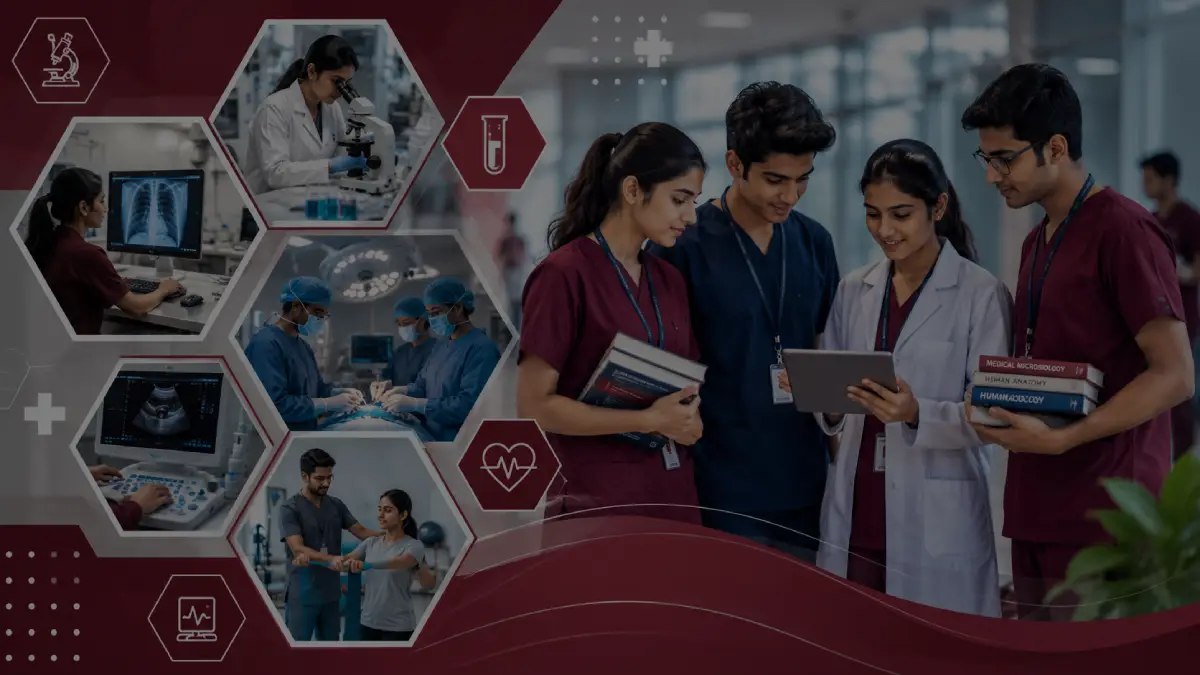
For students who have not secured the desired NEET rank or who wish to pursue a different route into the medical field, several well-established alternatives exist. Allied Health Science courses without NEET represent one of the fastest-growing pathways into India’s healthcare sector, and they constitute far more than a fallback option. These are skill-focused degree programmes that prepare students for direct roles in hospitals, diagnostic laboratories, operation theatres and cardiac units, frequently enabling graduates to enter employment sooner than peers in longer medical programmes.
Students who have completed Class 12 in the science stream already meet most of the entry requirements. This guide outlines the high-demand Allied Health Science courses without NEET available immediately after school, covering the curriculum focus, realistic salary expectations, and the admission process in detail. The pathway requires no competitive entrance examination and offers a clear, accessible route into a continually expanding profession.
Can I build a medical career without NEET?
The medical field extends well beyond the role of the physician. Every diagnosis depends upon a laboratory technologist who performs the test; every surgical procedure relies on an operation theatre technician who prepares and manages the theatre; and every radiological scan requires a trained radiographer. These professionals form the backbone of modern healthcare, and the overwhelming majority enter the profession without a NEET rank.
This is the foundation of non-NEET medical careers. Such pathways allow students to bypass the entrance-examination bottleneck and progress directly into job-oriented degree programmes. These courses are generally shorter than MBBS, more affordable, and permit earlier entry into the workforce. India’s healthcare sector continues to expand rapidly, with new hospitals, diagnostic chains and wellness centres opening each year, sustaining strong and consistent demand for skilled Allied Health Science professionals. For many students, this combination of early entry and reliable demand makes the non-NEET route a considered and practical choice rather than a secondary one.
A genuine and rewarding medical career is therefore entirely achievable without NEET. The principal consideration is identifying the pathway best suited to the individual student.
| Career path | NEET needed? | Resulting profession |
|---|---|---|
| Doctor (MBBS / BDS / BAMS / BHMS) | Yes | Physician, surgeon, dentist, AYUSH doctor |
| Allied Health Science (B.Sc.) | No | Lab technologist, radiographer, optometrist, OT technician |
| Pharmacy (B.Pharm) | No | Pharmacist, drug analyst |
| Biotechnology / Life Sciences | No | Researcher, biotechnologist |
| Nursing (B.Sc.) | Varies by state | Registered nurse |
Note: Admission norms for Nursing and Physiotherapy may vary by state and institution. Students are advised to confirm the current requirements directly with the institution concerned.
Know More: Allied Health Science Colleges in Mumbai: Top Courses, Eligibility, Fees and Career Scope (2026)
Which Allied Health Science courses do not require NEET?
The Allied Health Science courses without NEET set out below are full degree programmes that students may commence immediately after completing Class 12 with Physics, Chemistry, and Biology. Each programme prepares graduates for a specific, in-demand role, which is a principal reason employers value job-oriented medical courses of this nature. The following options merit consideration for the 2026 intake.
| Course | Duration | Primary function | Place of work |
|---|---|---|---|
| B.Sc. Medical Laboratory Technology (MLT) | 3 yrs | Conducts blood and tissue tests; supports diagnosis | Hospitals, diagnostic laboratories, blood banks |
| B.Sc. Radiography / Radio Imaging Technology | 3 yrs | Operates X-ray, CT, MRI, and ultrasound systems | Radiology departments, imaging centres |
| Bachelor of Optometry | 5 yrs | Performs eye examinations and vision care | Eye hospitals, optical clinics |
| B.Sc. Operation Theatre Technology (OTT) | 3 yrs | Assists surgeons; manages the OT and sterilisation | Surgical units, hospitals |
| B.Sc. Dialysis Technology | 3 yrs | Operates dialysis equipment for renal patients | Dialysis centres, nephrology units |
| B.Sc. Cardiology / Cardiac Technology | 3 yrs | Conducts ECG and echo; supports the Cath lab | Cardiology departments |
| B.Sc. Perfusion Technology | 3yrs | Operates heart-lung machines during surgery | Cardiac surgery units |
| B.Sc. Physician Associate | 3 yrs | Supports physicians in clinical care | Hospitals, clinics |
Know More: BSc Optometry vs BSc MLT: Comparing Two Popular Allied Health Careers
Allied Health Science specialisations offered at DY Patil University
DY Patil University’s School of Allied Health Sciences in Navi Mumbai offers the B.Sc. in Allied Health Science Technology across a comprehensive range of specialisations, each admitted on merit and does not require NEET:
- Medical Laboratory Technology
- Radiographic Technology (Radio Imaging)
- Cardiology Technology
- Perfusion Technology
- Dialysis Technology
- Operation Theatre Technology
- Central Sterilisation & Infection Control
- Physician Associate
- Healthcare, Social Science & Transplant Coordinator
- Clinical Research Data Management & Pharmacovigilance
- Bachelor of Optometry
This breadth of choice enables students to select a BSc Allied Health Science without NEET, aligned with their specific interests, whether in diagnostics, medical imaging, surgical support or eye care, rather than committing to a single predetermined path.
What is the eligibility for non-NEET healthcare courses?
A notable advantage of healthcare courses after 12th without NEET is the simplicity of their eligibility criteria. Admission depends not on a competitive rank but on the successful completion of the qualifying examination in the relevant subjects. The typical requirements for most PCB without NEET options are set out below.
| Requirement | General category | Reserved category |
|---|---|---|
| Qualification | Passed 10+2 or equivalent | Passed 10+2 or equivalent |
| Compulsory subjects | Physics, Chemistry, Biology (PCB) | Physics, Chemistry, Biology (PCB) |
| Minimum aggregate | Approximately 50% in each subject | Approximately 45% |
| Entrance examination | Not required (merit-based) or institution test | As per general category |
| Minimum age | 17 years | 17 years |
Several points merit attention. Certain courses accept students from the Physics, Chemistry and Mathematics (PCM) stream, although Biology remains the preferred, and in most cases required, subject. Cut-offs for reserved categories are generally lower. While many institutions offer direct merit-based healthcare admission, some conduct their own entrance test or interview. Applicants are therefore advised to verify the specific admission process of each institution before applying.
Know More: B.Sc. MLT Course Details 2026: Colleges, Fees, Eligibility and Career Scope in India
What salary can I expect without NEET?
Remuneration is an important consideration for any job-oriented qualification. Earnings from Allied Health Science courses without NEET vary according to the specific role, geographic location, and whether the position is in the government or private sector. The figures below represent typical industry ranges across India for 2026. They are indicative market averages rather than figures for any individual institution, and should be treated as a general guide.
| Role | Starting salary (fresher) | With 3-5 years’ experience |
|---|---|---|
| Medical Laboratory Technologist | ₹2.5-4 LPA* | ₹5-6.5 LPA* |
| Radiographer / Imaging Technologist | ₹2.5-4.5 LPA* | ₹5-7 LPA* |
| Optometrist | ₹3-5 LPA* | ₹6-10 LPA* |
| Dialysis Technologist | ₹2.5-4 LPA* | ₹5-7 LPA* |
| Cardiac / Perfusion Technologist | ₹3-5 LPA* | ₹6-9 LPA* |
| Operation Theatre Technician | ₹3-4.5 LPA* | ₹5-7 LPA* |
| Physiotherapist | ₹3-5 LPA* | ₹6-10 LPA* |
Several factors can increase these figures. Specialisation, for example, in molecular diagnostics or cardiac care, can raise earning potential considerably, as can additional professional certifications. Large corporate hospital chains generally offer higher compensation than smaller clinics. A substantial international dimension also exists: trained Allied Health Science professionals from India are in considerable demand across the United Kingdom, Canada, Australia, and the Gulf region, where salaries are significantly higher. Medical courses without NEET can therefore support a stable and progressive professional career.
Know More: BPH Course Details 2026: Eligibility, Fees, Syllabus and Duration
How do I get admission without NEET?
The admission process for programmes offering allied health without entrance exam requirements is notably straightforward, involving neither a competitive examination nor a prolonged counselling and ranking procedure. To secure a place on most Allied Health Science courses without NEET, the process is as follows.
- Complete Class 12 (10+2) with Physics, Chemistry, and Biology, meeting the minimum required aggregate.
- Identify the Allied Health Science course and institution best suited to one’s career objectives.
- Submit a direct application, online or offline. Many private universities offer direct admission Allied Health Science seats on a merit basis.
- Complete any institutional selection step where applicable. Some institutions conduct a short test or interview; many do not.
- Submit the required documentation, pay the applicable fees, and confirm admission.
Why choose DY Patil for an Allied Health Science career without NEET?
Having decided to pursue an Allied Health Science career without NEET, the choice of institution becomes the next significant consideration. The institution selected materially influences the quality of clinical training, the standing of the qualification, and the speed of entry into employment. DY Patil University in Navi Mumbai is a well-regarded option for allied health education, for the reasons set out below.
- Recognised accreditation: DY Patil is a NAAC A++ accredited, NIRF-ranked university, a standing widely recognised by healthcare employers.
- Breadth of specialisation: A comprehensive range of B.Sc. Allied Health Science Technology specialisations are available within a single institution.
- Hospital-based training: Students gain practical clinical experience through the university’s associated teaching hospital, an essential element in developing Allied Health Science competence.
- Modern infrastructure: Well-equipped laboratories and contemporary learning facilities.
- Strategic location: Situated in Sector 7, Nerul, within the Navi Mumbai healthcare corridor and in proximity to major hospitals and diagnostic centres.
- Merit-based admission: A straightforward, non-NEET admission process through direct application.
Collectively, these factors provide a sound foundation for converting a non-NEET entry point into an established healthcare career.
Is an Allied Health Science course the right choice for you?
Prospective students are encouraged to assess their own aptitudes before deciding. A Allied Health Science qualification is not merely an alternative to MBBS; it constitutes a distinct category of medical career, and it suits some students better than the conventional medical route. The following comparison is intended to support this assessment.
| Factor | Allied Health Science route | MBBS route |
|---|---|---|
| Entrance examination | None (merit-based) or institution test | NEET (highly competitive) |
| Course length | 3-4.5 years | 5.5 years plus PG |
| Fees | Generally lower | Generally higher |
| Time to first employment | Shorter | Longer |
| Core focus | Applied technical and clinical skill | Diagnosis and prescribing |
| Best suited to | Students inclined towards practical, laboratory and clinical work | Students intent on becoming a physician |
Students drawn to the applied dimension of medicine, such as conducting tests, operating specialised equipment, and contributing to the clinical team, will find an Allied Health Science degree a strong fit. Those whose objective is specifically to diagnose and prescribe as a physician should pursue MBBS through NEET. Neither route is inherently superior; they are simply different, and the most appropriate choice is the one that aligns with the individual’s strengths and professional aspirations. For a considerable number of students each year, the merit-based route into allied health proves the more suitable path.
Frequently Asked Questions
-
Is NEET compulsory for Allied Health Science courses?
No. NEET is required only for MBBS, BDS, and AYUSH degrees such as BAMS, BHMS, BUMS, and BSMS. Allied Health Science and allied health courses, including MLT, Radiology, Optometry, and Operation Theatre Technology, admit students based on Class 12 merit.
-
Which Allied Health Science course offers the highest salary without NEET?
Roles in Radiology, Optometry, Cardiac and Perfusion Technology, and Physiotherapy generally offer the highest remuneration, particularly with experience and specialisation. Salaries also rise considerably for those who work abroad.
-
Can a PCM student join Allied Health Science courses without Biology?
Some courses accept students from the PCM stream; however, Biology is preferred and, in most cases, required for clinical Allied Health Science programmes. Each institution’s subject criteria should be verified before applying.
-
How long do Allied Health Science courses take to complete?
Most B.Sc. Allied Health Science courses are of three to four years’ duration, including a clinical internship. Physiotherapy (BPT) is generally a 4.5-year programme.
-
Do Allied Health Science courses without NEET offer scope abroad?
Yes. Trained Indian Allied Health Science professionals are in strong demand in the United Kingdom, Canada, Australia, and the Gulf region, frequently following the completion of an additional licensing examination.
-
Can a master’s degree be pursued after an Allied Health Science qualification?
Yes. Graduates may pursue an M.Sc. in their specialisation or a related discipline, which typically enhances both professional standing and salary.
-
Is direct admission available without NEET?
Yes. Many private universities, including DY Patil, offer direct, merit-based admission to Allied Health Science courses with no NEET score required.
Conclusion
NEET represents one route into the medical profession, but it has never been the only one. Allied Health Science courses without NEET provide access to stable, respected, and well-remunerated healthcare careers without the requirement of a single competitive entrance examination. Demand for qualified professionals remains strong, salaries continue to rise, and the pathway begins immediately upon completion of Class 12. Students considering a healthcare career are encouraged to explore the B.Sc. Allied Health Science Technology specialisations are offered by DY Patil University’s School of Allied Health Sciences, and to apply directly, with no NEET score required.
Published on July 16, 2026
Contact us
