

B.Tech in Electronics & Computer Engineering
DYPU has an educational approach that seeks to create a learning experience that will prepare students for the realities of the modern world.


Programme
Overview
The B.Tech in Electronics and Computer Engineering at Ramrao Adik Institute of Technology (RAIT), DY Patil University, Navi Mumbai, is a four-year undergraduate engineering programme that integrates two core engineering branches into a single degree. The programme is designed to meet the latest demands of the electronics and computer industries in a rapidly growing engineering and technology sector. It delivers quality education and trains students in skills spanning both hardware and software development.
The curriculum follows a practical learning-based approach involving algorithm development to solve analytically complex problems in the Electronics Engineering and Computer Engineering domain. The result is a graduate equally comfortable working on the hardware side, the software side, or the meeting point of the two.
Programme highlights:
- Explores the fundamentals of enabling technologies including sensors, actuators, processors, communication networks, VLSI, and IoT.
- Interdisciplinary in nature, equipping graduates for careers in industry, higher studies, or entrepreneurship through domain knowledge in microelectronics, embedded system design, network security, cloud computing, big data analysis, web technology, computer architecture, software engineering, and allied fields.
- Provides sound knowledge in core areas of computational science and Information Technology to understand engineering trade-offs and build technical skill oriented to product development, higher study, and research.
- Curriculum updated regularly in consultation with industry and academic experts.
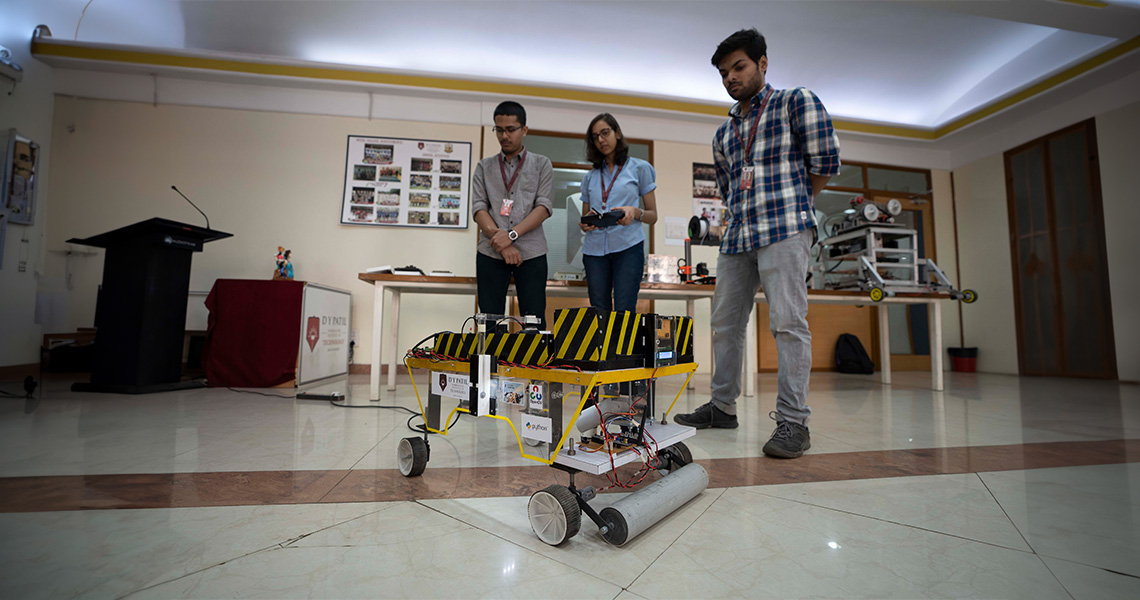
- Advanced curriculum and intensive hands-on laboratory work through projects and project-based learning, preparing students for diversified industries including automobile, healthcare, biomedical, defence, and agriculture.
- Supported by state-of-the-art laboratories in Signal and Image Processing, VLSI Design, Microprocessors and Microcontrollers, IoT, GPU Computing, and PCB Design.
- Inculcates high professionalism, ethical standards, and effective communication skills for individual and team work across professional environments related to social, economic, and emerging technologies.
- Periodic training programmes, workshops, seminars by industry and academic experts, and Summer or Winter internships keep students’ industry-ready in advanced Electronics Engineering and Computer Science Engineering fields.
- Imparts fundamental knowledge of Electronics and Computer Engineering hardware and software methods and tools for solving real-life and R&D problems, oriented to the fast-growing industry revolution.
- Covers fundamentals as well as advanced areas including basic electronics, embedded systems, VLSI systems, signal and image processing, algorithm development and analysis, big data, and information security.

Programme
Differentiator
- Hybrid B.Tech that integrates two core engineering branches, Electronics and Computer Engineering, into a single degree
- Equally strong on the hardware side (sensors, actuators, processors, VLSI, microprocessors, PCB) and the software side (algorithms, AI/ML, cloud, big data, web)
- Advanced coursework in Machine Learning, Artificial Intelligence, Data Science, IoT, Mobile and Wireless Communication, and Wireless Sensor Networks
- Industry 4.0 alignment with explicit focus on IoT, HPC, Data Science, Cloud, ML and Deep Learning, and Wireless and Mobile Computing
- Six specialised labs covering Signal and Image Processing, VLSI Design, Microprocessors and Microcontrollers, IoT, GPU Computing, and PCB Design
- Curriculum updated regularly in consultation with industry and academic experts
- Nine minor course options that broaden the student’s profile into adjacent areas
- Lateral entry route for diploma holders and eligible graduates
| Programme Details | |||
| Programme Name | B.Tech in Electronics and Computer Engineering (E&CE) | Fees (2026-27) | INR 4,50,000/- per year |
| Duration | 4 Years Full Time | Mode | Full Time, On Campus |
| Degree Awarded | Bachelor of Technology (B.Tech) in Electronics and Computer Engineering | Curriculum | As per NEP 2020, updated regularly with industry inputs |
| Laboratories | Signal and Image Processing, VLSI Design, Microprocessors and Microcontrollers, IoT lab, GPU Computing lab, PCB Design | Placement | 100% Placement Assistance |
| Lateral Entry | Available (direct entry to Second Year) | Minor Tracks | 9 minor course options including AI, Cloud Computing, Cyber Security, IoT, VLSI, Robotics & Drones, Data Science, AR/VR |
| Eligibility | HSC (PCM) 45% or Diploma 50% + valid entrance score | Accepted Tests | MHT-CET 2026 (PCM), JEE Main (Paper-1) 2026, SAT, DYPRAIT-ET 2026 |
Minor Course
Students in the B.Tech Electronics and Computer Engineering programme can choose from nine minor course options to broaden their profile.
| Minor Course | Minor Course |
| Artificial Intelligence | Cloud Computing |
| Cyber Security and Digital Forensics | Data Science |
| Robotics and Drones | Information Security and Blockchain |
| Internet of Things (IoT) | VLSI Systems Design |
| Augmented Reality ( AR ) / Virtual Reality ( VR ) |
Eligibility
Criteria
Candidates can apply to the B.Tech E&CE at RAIT either as First Year entrants from Class 12 or through the Lateral Entry route into the Second Year.
Eligibility for First Year (Class 12 Route)
- The candidate should have passed HSC or its equivalent examination with Physics and Mathematics as compulsory subjects along with one of the Chemistry/ Computer Science/ Electronics/ Information Technology/ Informatics Practices/ Biotechnology/ Technical Vocational subject/ Agriculture/ Engineering Graphics/ Business Studies/ Entrepreneurship, and obtained at least 45% marks (at least 40% marks, in case of Disability candidates belonging to Maharashtra State only) in the above subjects taken together.
- Diploma in Engineering and Technology with at least 50% marks (45% for Disability candidates belonging to Maharashtra State only).
- The candidate must have appeared in MHT-CET 2026 (PCM), JEE Main 2026 (Paper-1), Scholastic Assessment Test (SAT), or DYPRAIT-ET 2026, with nonzero scores in the qualifying examination.
Eligibility for Lateral Entry (Direct Second Year)
- Minimum three-year (or two-year Lateral Entry) Diploma examination with at least 45% marks (40% for reserved category) in any branch of Engineering and Technology.
OR
- Sc. degree from a recognised University as defined by UGC with at least 45% marks (40% for reserved category), and a 10+2 examination with Mathematics as a subject.
OR
B.Voc or 3-year D.Voc. stream in the same or allied sector.
Note: Admission cut-offs and dates change every cycle, so candidates should refer to the official RAIT admissions page before applying. International applicants are processed through the Internal Admission Cell.
Programme
Structure
Who should
opt for the Program
Our curriculum encourages a broad exploration of the design practice with an emphasis on user-centered approach and design thinking and beyond. We enable our students to develop critical, technical and managerial skills that align with the contemporary conversation within the industry also Entrepreneurial thinking for self-development by aligning with thought leaders in the industry. The course is focused on process-driven work that examines all aspects of industrial design from conception to implementation. We equip our students with a wide-range of design skills and thought process that allow them to articulate their design ideas and thinking. Our exemplary infrastructure and workshops support model making and prototype building for different kinds of design briefs.
Programme Outcomes
| Engineering knowledge: | Apply the knowledge of mathematics, science, engineering fundamentals, and an engineering specialization to the solution of complex engineering problems. |
| Problem analysis: | Identify, formulate, review research literature, and analyze complex engineering problems reaching substantiated conclusions using first principles of mathematics, natural sciences, and engineering sciences. |
| Design/development of solutions: | Design solutions for complex engineering problems and design system components or processes that meet the specified needs with appropriate consideration for the public health and safety, and the cultural, societal, and environmental considerations.. |
| Conduct investigations of complex problems: | Use research-based knowledge and research methods including design of experiments, analysis and interpretation of data, and synthesis of the information to provide valid conclusions. |
| Modern tool usage: | Create, select, and apply appropriate techniques, resources, and modern engineering and IT tools including prediction and modeling to complex engineering activities with an understanding of the limitations. |
| The engineer and society: | Apply reasoning informed by the contextual knowledge to assess societal, health, safety, legal and cultural issues and the consequent responsibilities relevant to the professional engineering practice. |
| Environment and sustainability: | Understand the impact of the professional engineering solutions in societal and environmental contexts, and demonstrate the knowledge of, and need for sustainable development. |
| Ethics: | Apply ethical principles and commit to professional ethics and responsibilities and norms of the engineering practice. . |
| Individual and team work: | Function effectively as an individual, and as a member or leader in diverse teams, and in multidisciplinary settings. |
| Communication: | Communicate effectively on complex engineering activities with the engineering community and with society at large, such as, being able to comprehend and write effective reports and design documentation, make effective presentations, and give and receive clear instructions. |
| Project management and finance: | emonstrate knowledge and understanding of the engineering and management principles and apply these to one’s own work, as a member and leader in a team, to manage projects and in multidisciplinary environments. |
| Life-long learning: | Recognize the need for and have the preparation and ability to engage in independent and life-long learning in the broadest context of technological change. |
Placements
Opportunities
At DY Patil, the Career Services Department and the RAIT Placement Cell offer customised placement support, mock interviews, resume reviews, group discussions, and recruiter engagement through the year. Industry exposure is built into the programme through projects, internships, the final-year capstone, and Summer or Winter industry training.
B.Tech E&CE graduates can explore roles across:
| Career Role | Career Role |
| Hardware Engineer | Software Engineer |
| Embedded Systems Engineer | VLSI Design Engineer |
| Hardware-Software Co-Design Engineer | IoT Engineer |
| Signal Processing Engineer | Image Processing Engineer |
| Microprocessor and Microcontroller Engineer | PCB Design Engineer |
| Network Security Engineer | Cloud Engineer |
| Wireless and Mobile Communication Engineer | Wireless Sensor Networks Engineer |
| Machine Learning / AI Engineer | Research and Development Engineer |
Industry Sectors
- Automobile and automotive technology
- Healthcare and biomedical
- Defence and aerospace
- Agriculture and agri-technology
- Private and public sector engineering organisations
- Consultancy firms
- Internet technology and IoT companies
- Electronics and computer hardware industry
- IT services and product companies
- Technology start-ups and innovation hubs
Top Recruiting Companies
Schieder Electric, Johnson Controls, Deepak Fertilisers, JIO, CISCO, NCR, Oracle, TCS, Capgemini, Accenture, Deloitte, Cognizant, Tech Mahindra, RIL, DOW Chemicals, Wissen Technology, Saint Gobain, EY, Nomura, Vector Consulting
Why Choose RAIT for B.Tech in Electronics and Computer Engineering
- Tech E&CE offered under DY Patil University with a strong reputation across India
- Hybrid programme integrating two core engineering branches (Electronics and Computer Engineering) into a single degree
- Curriculum delivered as per NEP 2020, updated regularly in consultation with industry and academia
- Six state-of-the-art laboratories in Signal and Image Processing, VLSI Design, Microprocessors and Microcontrollers, IoT, GPU Computing, and PCB Design
- Advanced coursework in Machine Learning, AI, Data Science, IoT, Mobile and Wireless Communication, and Wireless Sensor Networks
- Nine minor course options including AI, Cloud Computing, Cyber Security & Digital Forensics, Data Science, IoT, VLSI Systems Design, Information Security & Blockchain, Robotics & Drones and AR/VR
- Both First Year and Lateral Entry admission routes available
- Regular workshops, training programmes, and Summer or Winter internships with industry and academic experts
- International collaborations through edX (MIT and Harvard), Harvard Business School Online, and TCS
- Customised placement support through the DY Patil Career Services Department and the RAIT Placement Cell
LINK FOR
ADMISSION FORM
International Collaboration
The B.Tech Electronics and Computer Engineering programme benefits from RAIT and DY Patil University’s network of academic and industry partners, which give students exposure to global teaching content and current industry practice.
- Capgemini for industry engagement and skill-building
- LTM for industry engagement and skill-building
- Tata Consultancy Services (TCS) for industry engagement and skill-building
- itSMF for industry engagement and skill-building
FAQ's
- Q1. What is B.Tech in Electronics and Computer Engineering and how is it different from B.Tech ECE (Electronics and Communication Engineering)?
- Q2. What career opportunities are available after B.Tech Electronics and Computer Engineering in India?
- Q3. Who can apply for B.Tech Electronics and Computer Engineering at RAIT?
- Q4. What is the fee structure and duration of B.Tech E&CE at RAIT?
- Q5. What laboratories and tools will students work with during B.Tech Electronics and Computer Engineering?
Related
Programs


Contact us
