

Career Scope After Bachelor of Public Health in India: Jobs, Salary and Growth
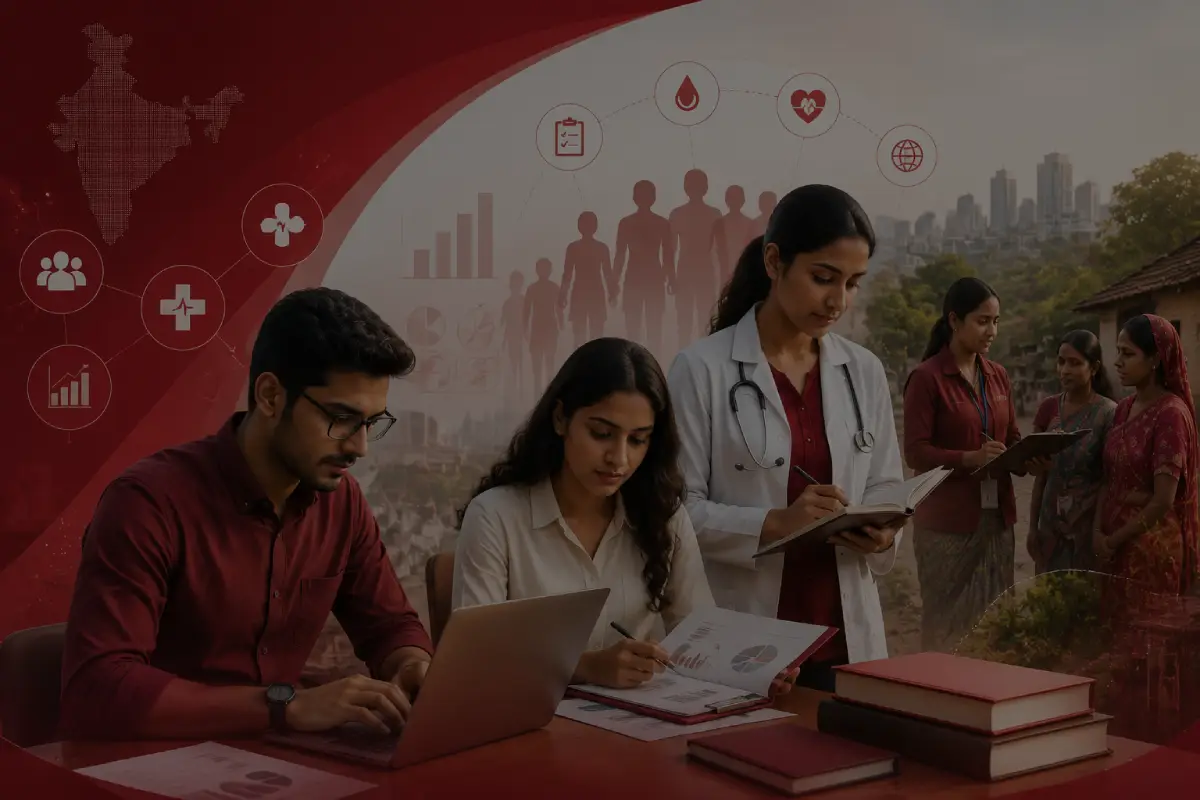
Here’s a question worth sitting with for a minute: who actually kept India running during the pandemic? Doctors, yes. Nurses, absolutely. But behind every vaccination drive, every containment zone, every district health dashboard, there was a small army of public health professionals doing the planning, the tracking, and the convincing. That’s exactly why the career scope after Bachelor of Public Health in India has expanded so dramatically over the last five years — and why students who once defaulted to MBBS or nursing are now looking seriously at this degree.
If you’re weighing your options after Class 12, or you’ve already enrolled and you’re wondering what comes next, this guide walks you through the full public health career scope in India, the jobs after BPH that hire freshers, realistic BPH salary in India figures from entry to senior level, government vs private vs NGO pathways, higher studies like the MPH, and the skills that genuinely move your pay upward. No fluff, just the picture as it stands in 2026.
Why Public Health Is a Fast-Growing Career in India
Let’s start with the obvious. India spends more on health today than at any point in its history, and a growing share of that money goes into prevention, surveillance, and policy, not just hospitals. The National Health Mission, Ayushman Bharat, the rollout of Health and Wellness Centres, and post-COVID investments in disease surveillance have all created roles that simply didn’t exist at this scale a decade ago. And every one of those roles needs trained people.
Three forces are driving the scope of public health degree holders right now:
- Government expansion. Programs like the National Health Mission and integrated disease surveillance recruit programme officers, community health staff, and data personnel at district and block level across every state.
- The rise of health-tech. India’s digital health push such as telemedicine, the Ayushman Bharat Digital Mission, health analytics startups that need people who understand both health systems and data.
- Global and NGO funding. International agencies and large NGOs run long-term programmes in India on nutrition, maternal health, TB, and immunisation, and they hire public health graduates in large numbers.
Put simply: disease patterns are shifting, populations are ageing, and prevention is finally getting the budget it deserves. A public health career sits right at that intersection. It’s one of the few fields where social impact and job security genuinely travel together.
Know More: Public Health Courses After 12th
Top Job Roles After BPH
So what do you actually do with this degree? The honest answer: quite a lot. The public health job roles open to BPH graduates fall into two broad buckets — fieldwork and policy on one side, data and management on the other. Most students discover their preference during internships, so don’t stress about choosing on day one.
Roles in Epidemiology, Policy & Community Health
These are the classic jobs after BPH, the roles people picture when they think of public health. They involve communities, disease patterns, and the systems that connect the two.
| Job Role | What You’ll Actually Do | Typical Entry Salary |
| Epidemiologist (Junior/Research Associate) | Track disease outbreaks, analyse infection patterns, support surveillance units like IDSP and NCDC. | ₹4 – 8.5 LPA |
| Health Policy Analyst | Research health programmes, evaluate what’s working, draft policy briefs for governments and think tanks. | ₹4.5 – 8 LPA |
| Community Health Officer | Lead primary care delivery at Health & Wellness Centres; the frontline of the National Health Mission. | ₹3 – 6 LPA |
| Public Health Programme Officer | Coordinate immunisation, nutrition, or TB programmes between state health societies and field teams. | ₹4 – 7.5 LPA |
| Health Educator / Promotion Specialist | Design awareness campaigns and behaviour-change communication for communities. | ₹3 – 5.5 LPA |
Roles in Health-Tech, Data & Administration
Here’s where the field has changed the most. Health systems now generate enormous amounts of data, and someone has to make sense of it. If you enjoy numbers, dashboards, or management, these public health job roles tend to pay faster and scale higher.
| Job Role | What You’ll Actually Do | Typical Entry Salary* |
| Biostatistician (Entry-Level) | Design studies, run statistical analysis for clinical trials, research institutes, and pharma. | ₹4.5 – 8 LPA |
| Healthcare Administrator | Manage hospital operations, quality accreditation (NABH), and patient-flow systems. | ₹3.5 – 7 LPA |
| Health Data Analyst | Build dashboards and reports for health-tech firms, insurers, and government health missions. | ₹4 – 9 LPA |
| M&E (Monitoring & Evaluation) Associate | Track programme indicators, audit data quality, and report outcomes to funders. | ₹4 – 7 LPA |
| Health Insurance / Claims Analyst | Analyse utilisation and risk for insurers and TPAs in the growing health insurance market. | ₹3.5 – 6.5 LPA |
Salary ranges are indicative, compiled from published salary aggregators and sector reports as of 2026. Actual offers vary by city, organisation, and skill set — always confirm with the employer or the university’s placement cell.
Public Health Salary in India (Entry to Senior Level)
Let’s talk about money, because that’s probably why half of you are here and fair enough. The BPH salary in India follows a fairly predictable curve: modest at entry, then climbing sharply once you add either a master’s degree or five-plus years of programme experience. Here’s how the progression typically looks.
| Career Stage | Experience | Typical Salary Range | What Moves You Up |
| Entry level | 0 – 2 years | ₹3 – 6 LPA | Internships, field exposure, basic data skills |
| Early-mid level | 2 – 5 years | ₹5 – 9 LPA | Programme management experience, an MPH |
| Mid-senior level | 5 – 8 years | ₹8 – 15 LPA | Specialisation (epidemiology, M&E, policy), team leadership |
| Senior / leadership | 8+ years | ₹12 – 25 LPA+ | State or national programme leadership, international agency roles |
A few honest observations. First, government contractual roles often start lower but offer unmatched stability and field credibility. Second, international agencies and consulting firms pay the most, but they almost always expect a master’s degree. Third, the gap between an average performer and a skilled one is wide in this field — graduates who can handle data analysis, grant writing, or programme evaluation routinely out-earn peers within three years. The career scope after Bachelor of Public Health in India rewards skill-stacking more than seniority alone.
Where Do Public Health Graduates Work?
One underrated strength of this degree is the sheer variety of employers. Public health graduates in India work across government health departments, hospitals, NGOs, research institutes, health-tech startups, insurance companies, CSR foundations, and international agencies such as the WHO, UNICEF, and the World Bank’s health portfolios. Few degrees open doors in this many directions at once.
Government vs Private vs NGO Careers
Each sector has a distinct personality, and choosing between them is really about what you want your working life to feel like. Here’s a side-by-side view.
| Factor | Government | Private Sector | NGO / International |
| Typical roles | CHO, district programme officer, surveillance staff under NHM/NCDC | Hospital admin, health-tech analyst, insurance, pharma research | Programme officer, M&E specialist, field coordinator |
| Entry salary | ₹3 – 6 LPA | ₹3.5 – 8 LPA | ₹4 – 8 LPA |
| Job security | Highest (especially permanent posts) | Performance-linked | Project/funding-linked |
| Growth speed | Steady, structured | Fast for skilled performers | Fast, with global exposure |
| Best for | Stability + grassroots impact | Pay growth + corporate skills | Field impact + international careers |
Plenty of professionals mix and match, by the way. A common path: two years in an NGO field role, an MPH, then a government or international agency position. The sectors talk to each other constantly, so early choices rarely lock you in.
Higher Studies After BPH (MPH & Beyond)
Should you study further? For most ambitious graduates, the answer is yes — and the timing matters less than people think. The MPH (Master of Public Health) is the natural next step and the single biggest salary lever in this field. It typically lifts starting packages into the ₹5 – 9 LPA band and unlocks roles at international agencies, research institutes, and policy bodies that simply don’t consider bachelor’s-only candidates.
| Pathway | Duration | Best Suited For |
| MPH (Master of Public Health) | 2 years | Programme leadership, epidemiology, global health careers |
| Master of Public Policy (MPP) | 2 years | Health policy, governance, and think-tank roles |
| MPH–Ph.D. integrated track | 5+ years | Research, academia, and senior scientific roles |
| M.Sc. (Epidemiology / Biostatistics) | 2 years | Data-heavy research and analytics careers |
| MBA (Healthcare / Hospital Management) | 2 years | Hospital administration and health business roles |
Where you study matters as much as what you study. DY Patil University, Navi Mumbai runs a dedicated School of Public Health — established in 2020, when the pandemic made the case for stronger public health systems impossible to ignore — offering a Bachelor of Public Health (BPH Hons.) alongside an MPH, a Master of Public Policy, an Executive MPH for working professionals, and an integrated MPH–Ph.D. The school takes an integrative approach across public health, environment, and policy, which mirrors how the field actually works on the ground. And because the university campus houses its own teaching hospital ecosystem, students get clinical-setting exposure that standalone public health schools struggle to offer. For current curriculum, eligibility, and fee details, it’s always best to check with the admissions office directly.
Skills That Boost Your Public Health Career
Here’s something most career pages won’t tell you: in public health, your degree gets you the interview, but your skills decide your salary. Recruiters across government missions, NGOs, and health-tech firms keep flagging the same gaps — so if you build these early, you’ll stand out fast.
- Data analysis & biostatistics — comfort with Excel, R, SPSS, or Python is the single most reliable pay-booster in the field.
- GIS mapping & surveillance tools — disease mapping skills are increasingly demanded by state surveillance units and research bodies.
- Monitoring & Evaluation (M&E) — funders run on indicators; people who can design and audit them are always in demand.
- Health communication — behaviour-change campaigns live or die on messaging; strong writing and local-language fluency matter.
- Grant and proposal writing — NGOs and research groups actively prefer candidates who can help bring funding in.
- Project management — coordinating field teams, budgets, and timelines is the core of nearly every senior role.
Notice a pattern? None of these require a second degree. Short certifications, internships, and volunteering with district health programmes can build most of this toolkit while you’re still studying — which is exactly why hands-on, fieldwork-heavy BPH programmes give graduates a head start.
The Future of Public Health in India
Where is all this heading? Upward, by almost every measure. India’s disease burden is shifting from infections to lifestyle conditions — diabetes, hypertension, mental health — and managing that shift is a public health job, not just a clinical one. Climate-linked health risks, urban air quality, and pandemic preparedness are pulling environment and health into one conversation. Meanwhile, the digital health mission is creating data roles faster than universities can fill them.
There’s a global angle too. Indian public health professionals are increasingly recruited by international agencies and global health programmes, and an Indian MPH plus field experience travels well. Salaries abroad are higher in absolute terms — public health roles in the US, UK, or Australia commonly pay several times the Indian equivalent — but India offers something rarer: scale. Nowhere else can a young professional influence health outcomes for millions within their first decade of work. Many graduates now build careers that straddle both, working on India-based programmes funded and run by global organisations.
The bottom line? The career scope after Bachelor of Public Health in India isn’t a trend that peaked with the pandemic — it’s a structural shift in how the country invests in health. Graduates entering the field now are positioned for a decade of growing demand, widening roles, and genuinely meaningful work. If you want a career where the scope of public health degree keeps expanding while you grow with it, this is about as good as timing gets.
Frequently Asked Questions
1. What is the career scope after a Bachelor of Public Health in India?
The career scope after a Bachelor of Public Health in India spans government health programmes, NGOs, hospitals, research institutes, health-tech companies, and international agencies. Common roles include epidemiologist, community health officer, health policy analyst, biostatistician, and healthcare administrator, with strong growth driven by national health missions and digital health expansion.
2. What jobs can I get immediately after BPH?
Fresh BPH graduates typically start as community health officers, programme assistants, health educators, M&E associates, health data analysts, or junior research associates. Government missions, NGOs, hospitals, and health-tech startups all hire at the entry level.
3. What is the average BPH salary in India?
Entry-level BPH salaries in India generally range from ₹3 to 6 LPA. With 5–8 years of experience or an MPH, professionals commonly earn ₹8–15 LPA, while senior leadership and international agency roles can cross ₹20–25 LPA. Figures vary by sector, city, and skills, so verify current offers with employers.
4. Is an MPH necessary after a Bachelor of Public Health?
It isn’t mandatory, but it’s strongly recommended for long-term growth. An MPH significantly raises starting salaries and is often a minimum requirement for roles at international agencies, research institutes, and senior government programme positions.
5. Can BPH graduates work with WHO or other international organisations?
Yes. International bodies such as WHO, UNICEF, and large global health NGOs hire Indian public health professionals, usually for candidates with a master’s degree and solid field experience. Starting with NGO or government programme roles in India is the most common route in.
6. Government job or private job, which is better after BPH?
It depends on your priorities. Government roles offer stability and grassroots impact, private-sector roles offer faster pay growth, and NGO or international roles offer field experience and global exposure. Many professionals move between sectors over a career.
7. Which skills increase salary the most in public health?
Data analysis (R, SPSS, Python), monitoring and evaluation, GIS-based disease mapping, grant writing, and project management consistently deliver the biggest salary jumps for public health professionals in India.
8. Does DY Patil University offer public health programmes?
Yes. The DY Patil School of Public Health in Navi Mumbai, established in 2020, offers a Bachelor of Public Health (BPH Hons.), an MPH, a Master of Public Policy, an Executive MPH for working professionals, and an integrated MPH–Ph.D., with an integrative approach across public health, environment, and policy. Contact the admissions office for current eligibility and fee details.
Published on June 18, 2026
Contact us
